A Norwegian faced with the need to keep related paper documents together designed and patented his version of the paper clip in 1899. It proved to be one loop too short of the ideal shape! Johan Vaaler (1866-1910) had a background in electronics and mathematics and worked in an “invention office” in Norway. His need to maintain voluminous paper records led him to devise a paper clip. For the prior several hundred years, a ribbon slipped through linear slots cut in the same location in each page was used to bind related paper documents. For a very short time before the paper clip, some used a straight pin to attach paper documents to each other. An American physician had invented the straight pin to hold cloth together for tailoring.
Vaaler initially obtained a patent for his invention in Germany and a few years later in the United States; Norway did not have patent laws at the time. Vaaler neither improved nor marketed his invention. Unknowingly to Vaaler, Gem Manufacturing Limited in the United Kingdom, had produced and marketed but not patented a paper clip. Theirs was a “double-U” slide-on paper clip. Subsequently, it was called, generically, the “Gem paper clip”, no matter the manufacturer. (Figs.1 and 2a) It was superior to Vaaler’s original single loop clip (Fig 2b). Other companies have developed other shapes and sizes for the paper clip. (Fig. 2c) This odd sequence of events reflected the limited communications among nations on such topics and the ease of patenting at that time. Vaaler’s patents gave him some priority and the idea was very likely his own since the Gem paper clip, apparently, was neither known nor present in Norway at the time of his work.
Figure 1. The “Gem” double loop clip.
Fig. 2. A. Gem double loop. B. Vaaler’s single loop. C. Modern heavy duty
Although Vaaler neither improved nor marketed his original paper clip, the Norwegians took pride in his recognition as the inventor of this simple, but very useful, device. At the time of the German occupation of Norway during World War II, the Norwegians used various symbols of resistance. These included the more obvious buttons with the likeness or initials of their King, Haakon VII, who was in exile. Arrest would follow such overt acts. As a substitute, they wore paper clips on their shirt or jacket as a symbol of Norwegian solidarity against their Nazi occupiers.
King Haakon, a Norse name he assumed after he was crowned, was much beloved and respected by Norwegians. He had been Prince Carl in Denmark. When Norway negotiated their separation from a union with Sweden under the reign of the King Oscar II of Sweden. Prince Carl was elected King of Norway by popular referendum: a unique method to choose a King. After the referendum, in 1905, he was given the crown in a ceremony of the Norwegian Storting, its legislature.
In 1940, the Germans invaded Norway, virtually unopposed by a weaker Norwegian military. The Nazis needed to secure Norwegian ports from which Swedish steel was shipped, assuring the Third Reich a supply to underpin its war machine and depriving access to the allies. King Haakon, refusing to be a German puppet, escaped to England through Sweden. From that haven, he led and encouraged his people through radio broadcasts and other means during the war. Norwegians used the paper clip on one’s lapel or shirt, a patented Norwegian innovation, as a symbol of resistance during the Nazi occupation.
Today a 7-meter tall paper clip monument honors Johan Vaaler, although the statue depicts the Gem paperclip, not Vaaler’s specific design (Figure 3). The statue was originally placed outside a commercial college in Sandvika, near Oslo. It was later moved to the BSN student houses in another site.
Figure 3. Statue of paper clip in Norway in recognition of Vaaler.
On Thursday, E. Jean Carroll started it: Paper Clip Protest.
“Comely Reader! I suggest we all start wearing the paper clip. Subtler than a red hat, more powerful as a CONNECTION,” she wrote, explaining they were also worn during World War II as a sign of resistance against the Nazis.
Norwegian teachers and students wore paper clips to signal their opposition to Nazi occupation. They attached them to their lapels and wore them as jewelry, a symbol of solidarity binding them together as paper clips did with papers. It was a quiet act of defiance, expressing that Norwegians remained united against Nazi rule.
Friday, when I signed on to tape the #SistersInLaw Podcast, Jill Wine Banks had a clip delicately attached to the collar of her shirt. It made me smile. In that moment, I knew E. Jean was onto something. Our defiance can and must be loud and public at this point. But the quiet symbol of solidarity on someone’s collar when you walk into a crowded room? Genius. And much better than a red hat.
You probably have a paper clip in your desk or junk drawer that you can put on straight away. You can be a subtle signal of support for people who need that right now. You can be a conservation starter. Jill tells me she’s having special paper clips made for the occasion—very fitting for a woman known for wearing pins—and has promised to send me one.
Small efforts can bear fruit when we’re all in on them. I’m going to find a paper clip before I head out to the farmers’ market.
We’re in this together,
Joyce
Posted inprotests|Comments Off on Paper Clip Protest – The Norwegian Resistance During World War II and the Paper Clip
A new baby orca was spotted off the coast of Alki in Seattle! When asked for comment, the parents responded with a whale song demanding that the Epstein files be released. – Seattle Fun Events
The inscription is part of the Franklin Delano Roosevelt Memorial in Washington, D.C. It reflects his commitment to civil rights and liberties during his presidency, emphasizing that oppression, injustice, and hatred undermine the very foundations of civilization.
A Pulitzer Prize finalist in the cartoonist category, Pat Bagley has worked for The Salt Lake Tribune for more than 45 years. He is one of roughly a dozen cartoonists still working at a major metropolitan newspaper in the U.S.
Bagley started working for The Tribune shortly after graduation and has published more than 6,000 cartoons for the now-nonprofit newsroom.
His cartoons have appeared in The Washington Post, The Guardian, The Wall Street Journal and the Los Angeles Times. He is syndicated and appears in more than 450 American newspapers.
Pat was born in Utah and grew up in Oceanside, California, where his father was the mayor and his mother a schoolteacher.
As a member of The Church of Jesus Christ of Latter-day Saints, he served a mission in Bolivia in the 1970s. In 1978, he received his degree in political science from Brigham Young University. In 2009, following statements by LDS apostle Dallin Oaks about gay marriage protesters and religious freedom, Bagley commented that he was retired from the church, though not bitter.
Posted inUncategorized|Comments Off on Bagley Cartoon: No Jesters
Sometimes when I have nothing better to do, I think back on the elections we had in the before times — when, say, Mitt Romney ran against Barack Obama or John Kerry ran against George W. Bush. I try to figure out why politics and society in general felt so different then.
It’s not because we didn’t have big disagreements back then. The Iraq war kicked up some pretty vehement arguments. It’s not because we weren’t polarized. Pundits have been writing about political polarization since at least 2000 and maybe well before.
Politics is different now because something awful has been unleashed. William A. Galston defines this awful thing in his fantastic new book, “Anger, Fear, Domination: Dark Passions and the Power of Political Speech.” Even before the Charlie Kirk assassination it was obvious that the dark passions now pervade the American psyche, and thus American politics.
A core challenge in life is how do you motivate people to do things — to vote in a certain way, to take a certain kind of action. Good leaders motivate people through what you might call the bright passions — hope, aspiration, an inspiring vision of a better life. But these days, and maybe through all days, leaders across the political spectrum have found that dark passions are much easier to arouse. Evolution has wired us to be extremely sensitive to threat, which psychologists call negativity bias.
Donald Trump is a man almost entirely motivated by dark passions — hatred, anger, resentment, fear, the urge to dominate — and he stirs those passions to get people to support him. Speaking before a CPAC conference in 2023 he warned of “sinister forces trying to kill America,” by turning the nation into a “socialist dumping ground for criminals, junkies, Marxists, thugs, radicals and dangerous refugees that no other country wants.”
Trump is a master of this dark art, but I wouldn’t say my Trump-supporting friends have darker personalities than my Trump-opposing ones. Progressives also appeal to dark passions. A decade or so ago I had a poignant conversation with a Democratic ad-maker who was anguished because to help his candidates, nearly every ad he made was designed to arouse fear and animosity. “The thing people forget is that the political left were really the ones who perfected the politics of anger,” the left-wing social organizer Marshall Ganz told Charles Duhigg for an essay in The Atlantic in 2019. “It’s the progressives who figured out that by helping people see injustice, rather than just economics, we become strong.” Michael Walzer, the eminent co-editor emeritus of the progressive magazine Dissent, put it clearly, “Fear has to be our starting point, even though it is a passion most easily exploited by the right.”
We in the media appeal to those passions too. One of our jobs is to motivate you to click on our headlines. A team of researchers from New Zealand looked at headlines from 47 American publications. They found that between 2000 and 2019, the share of headlines meant to evoke anger more than doubled. The prevalence of headlines meant to evoke fear rose by 150 percent. (continue on page 2 or here)
I want to understand how dark passions are ruling us, so let’s take a quick look at each one:
Anger. Anger rises when somebody has damaged something you care about. Anger can be noble when directed at injustice. But the seductive thing about anger is that it feels perversely good. It makes you feel strong, self-respecting and in control. Expressing anger is a dense form of communication. It lets people know, quite clearly, that you want something to change. The problem is that these days we don’t have just bursts of anger in our public life. Anger has become a permanent condition in many of our lives.
Hatred. You can be angry at someone you love. Hatred, on the other hand, is pervasive. As Galston writes, “We feel anger because of what someone has done, hatred because of who someone is.” The person who hates you wants to destroy you. Antisemites hate Jews. During the Rwandan genocide, the Hutus hated the Tutsis. “Hatred cannot be appeased,” Galston continues, “it can only be opposed.”
Resentment. Resentment is about social standing. Someone makes you feel inferior to them. Someone doesn’t offer you recognition and respect. Resentful people are curled in on themselves. They can’t stop thinking about and resenting the people who are so lofty that those other people may not even know they exist. Anger is often expressed, but resentment is often bottled up because the person in its grip feels powerless, socially inferior.
Sign up for the Opinion Today newsletter Get expert analysis of the news and a guide to the big ideas shaping the world every weekday morning. Get it sent to your inbox.
Fear. Fear is healthy when it alerts you to some real threat. But as the sociologist Zygmunt Bauman has noted, “Fear is at its most fearsome when it is diffuse, scattered, unclear, unattached, unanchored, free-floating, with no clear address or cause.” When that happens fear turns into a feeling of existential menace that doesn’t lead to any clear course of action. When fear turns into terror, it makes rational deliberation almost impossible. When people can’t locate the source of their fear, you never know who they will lash out at and blame; you just know that a scapegoat will be found.
The Urge to Dominate. This is the one we talk about least, but it is the darkest of the dark passions, the most omnipresent and the most destructive. St. Augustine called it libido dominandi. It’s the urge to control, to wield power over someone, to make yourself into a god. It is often driven by repressed anxiety, insecurity and a fear of abandonment that causes people to want to establish their power in every situation. It exists in personal life and causes some people to try to manipulate you, interrupt and talk over you. In families, it leads to overbearing parenting, conditional love, boundary violations and isolation tactics — cutting someone off.
In intellectual life, it causes some people to want to dominate reality, to impose their own false view of the truth on everyone around them. People with a strong urge to dominate can’t stand the condition of doubt. They want to impose brutal certainties and crude simplifications.
Politics is about power, so of course it attracts people with a strong libido dominandi. When that urge is combined with what psychologists call a “dark triad” personality type (Machiavellianism, narcissism and psychopathy), you wind up with some pretty brutal characters — Hitler, Mao, Stalin.
In public life the urge to dominate can take brutal forms. When you see cops beating a man who is on the ground and barely conscious, that’s the urge to dominate. It can also take more subtle forms. I’m struck by how powerful the human urge to segregate and exclude is. For example, once left-leaning people established a dominant position in academia, the media and nonprofit sector, they mostly excluded conservative and working-class voices. They wanted control.
Dark passions are part of our nature, like keys on a piano. If we’re bombarded with speech that presses the dark keys, antipathy will rise. When people consume communication that demonstrates respect, curiosity, communion and hope, antipathy falls. The problem is that dark passions are imperial. Once they get in your body, they tend to spread. Dark passions drive out the good ones.
Today American politics is driven by dueling fears, hatreds, resentments. If liberal democracy fails, it will be because a variety of forces have undermined the emotional foundations on which liberalism depends. Dark passions lead to heartlessness, cruelty, violence, distrust. Sticks and stones can break your bones, but words that arouse the dark passions can kill you.
America’s founding fathers spent a lot of time thinking about dark passions. Samuel Adams declared that humans are driven by “ambitions and lust for power.” Patrick Henry confessed that he had come to “dread the depravity of human nature.” John Jay declared, “The mass of men are neither wise nor good.”
They preferred democracy because they didn’t trust one man or one small group of people to hold power. They thought it more prudent to spread power around, and then in the Constitution, imposed all sorts of ways to check human desire.
Since then, and especially over the last 60 years, there has been a great loss of moral knowledge, a naïveté about and ignorance of dark passions. “Sinful” used to be a powerful, resonant, soul-shaking word. Now it is mostly used in reference to desserts. “When I think back to my years of growing up in the 1950s,” Andrew Delbanco once wrote, “I realize that this process of unnaming evil, though it began centuries ago, has accelerated enormously during my lifetime.”
How did we get so ignorant about the struggle between light and dark forces within us? Well, religion is all about that struggle, and religion plays a smaller role in public life. After World War II, an array of thinkers, including those in the self-esteem movement, argued that human nature is essentially good. If there’s evil in the world, it’s out there in social structures, not in ourselves. In the 1950s and 1960s, psychology became the primary way people understood themselves. The psyche replaced the soul and symptoms replaced sin. Then we privatized morality. Schools, for example, got out of the moral-formation business and into the career prep business. We told successive generations to find your own values, find your own truth. That’s like telling someone to find your own astrophysics. If we don’t have teachers and leaders guiding us through the long human tradition of moral knowledge, we’re going to wind up pretty damned ignorant.
This mass ignorance has produced obliviousness. All day we are consuming spiritual nutrients that either make us a little more elevated (that documentary about Mr. Rogers) or a little more degraded (porn and sports gambling) and yet our culture seems blind to this everyday contest. Most of all this ignorance has produced naïveté about human nature, a blithe innocence about the forces that arouse dark passions and what those passions can lead to. For example, many people now believe that democracy means majority rule. The founders, who were much wiser about human nature than we are, were under no illusions about the horrors and atrocities majorities could do when in the grip of dark passions. That’s why they built in the checks and balances now being shredded.
There is one force above all others that arouses dark passions, and we possess it in abundance: humiliation. People feel humiliated when they are not granted equal standing and when they have been deprived of something they think is their right. And as we all know, pain that is not transformed gets transmitted. Humiliated people eventually lash out.
Humiliation drives world events. Germany was humiliated at the end of World War I. The Arab world was humiliated after its defeat in the Six Day War. Russia was humiliated by its defeat in the Cold War. The China scholar William Callahan wrote, “The master narrative of modern Chinese history is the discourse of the century of national humiliation.”
Humiliation produces horrors at home. Since the Columbine shooting we’ve had a long string of humiliated and solitary men brooding over their insults and then finding a psychic solution through the gun. Over the last 60 years the educated elite has created a meritocracy, an economic system and a cultural atmosphere that serves itself and leaves everybody else feeling excluded and humiliated. Over the last 30 years the richest, whitest and best-educated members of our society have become the most extreme people on the right and the left and began a war on each other that leaves all sides feeling furious and fearful. I’m not the only one to wonder if history would have been different if then-President Barack Obama hadn’t humiliated Donald Trump at a White House Correspondents’ Association dinner.
So to return to my original question: Why does politics feel so different now than in times past? My short answer is that over these years, demagogues in politics, in the media and online have exploited common feelings of humiliation to arouse dark passions, and those dark passions are dehumanizing our culture and undermining liberal democracy. My intuition is that we’re only at the beginning of this spiral, and that it will only get worse.
How can we reverse our downward trajectory? First, let me tell you how not to reverse it. There is a tendency in these circumstances to think that the other side is so awful that we need a monster on our side to beat it. That’s the decision Republicans made in nominating Trump. Democrats are moving in that direction too. Back in 2016 Michelle Obama asserted that Democrats to go high when Republicans go low, but the vibe quickly shifted. As former Attorney General Eric Holder put it in 2018: “When they go low, we kick ’em. That’s what this new Democratic Party is about.” If Republicans soil our democracy with extreme gerrymandering in Texas, Gavin Newsom and the Democrats will soil our democracy in California.
The problem with fighting fire with fire is that you’re throwing yourself into the cesspool of dark passions. Do we really think we won’t be corrupted by them? Do we really think the path to victory lies in becoming morally indistinguishable from Trump? Do we really think democracy will survive? Surveys consistently show that most Americans are exhausted by this moral race to the bottom and want an alternative; do we not trust the American people?
I often hear Democrats say their party needs to fight harder. These are people who don’t really believe in democracy. Fighting is for fascists. Democracy is about persuasion. Democrats would do well to get out of their urban and academic bubbles and understand the people they need to persuade and then persuade harder.
History provides clear examples of how to halt the dark passion doom loop. It starts when a leader, or a group of people, who have every right to feel humiliated, who have every right to resort to the dark motivations, decide to interrupt the process. They simply refuse to be swallowed by the bitterness, and they work — laboriously over years or decades — to cultivate the bright passions in themselves — to be motivated by hope, care and some brighter vision of the good, and to show those passions to others, especially their enemies.
Vaclav Havel did this. Abraham Lincoln did this in his second Inaugural Address. Alfred Dreyfus did this after his false conviction and Viktor Frankl did this after the Holocaust. You may believe Jesus is the messiah or not, but what gives his life moral grandeur was his ability to meet hatred with love. These leaders displayed astounding forbearance. They did not seek payback and revenge.
Obviously, Martin Luther King Jr. comes to mind: “To our most bitter opponents we say: We shall match your capacity to inflict suffering by our capacity to endure suffering. We shall meet your physical force with soul force. Do to us what you will, and we shall continue to love you. We cannot in all good conscience obey your unjust laws, because noncooperation with evil is as much a moral obligation as is cooperation with good. Throw us in jail, and we shall still love you.”
Obviously, Nelson Mandela comes to mind. Far from succumbing to dark passions, he oriented his life toward a vision of the good. “During my lifetime,” he said near the beginning of his imprisonment, “I have dedicated my life to this struggle of the African people. I have fought against white domination, and I have fought against Black domination. I have cherished the ideal of a democratic and free society in which all persons will live together in harmony and with equal opportunities.”
This kind of interruption is the most effective way to fight dark passions. Though it’s true that humans are deeply broken, we’re also gloriously made. We’re wired not only to dominate, but also with the bright passions too: the desires for belonging, justice, meaning, understanding and care. Moral life is a struggle over which parts of ourselves we will develop. Political leadership is a struggle over which motivations the society will develop. The British writer Henry Fairlie put it well, “At least if we recognize that we sin, know that we are individually at war, we may go to war as warriors do, with something of valor and zest and even mirth.”
Galston, who is a political theorist, revives the ancient tradition that emphasizes that speech and rhetoric have tremendous power to arouse or suppress these passions. When we choose our leaders we are not only choosing a set of policies but the moral ecology they create with their words. He also points out that in the early 2000s, as millions of manufacturing jobs went away, the national leadership class barely stopped to notice.
I’d add only that in order to repress dark passions and arouse the good ones, leaders need to create conditions in which people can experience social mobility. As philosophers have long understood, the antidote to fear is not courage; it’s hope. If people feel their lives and their society are stagnant, they will fight like scorpions in a jar. But if they feel that they personally are progressing toward something better, that their society is progressing toward something better, they will have an expanded sense of agency, their motivations will be oriented toward seizing some wonderful opportunity, and those are nice motivations to have.
The dark passions look backward toward some wrong committed in the past and render people hardhearted. The bright passions look forward toward some better life and render people tough-minded but tenderhearted.
Ed note: Some have inquired as to where they can find an advance directive that includes the Durable Power of Attorney for Health Care as well as their goals of care when faced with a life threatening illness. This form can be viewed or printed here or from the Washington State Medical Society (WSMA) website.
MEMPHIS (The Borowitz Report)—Abandoning their customary black vests and masks, ICE agents have gone undercover in Memphis, DHS Secretary Kristi Noem confirmed on Wednesday.
Noem defended her department’s expenditure of $85,000 to outfit the agents in sequined jumpsuits, arguing that such a disguise was necessary for ICE to blend into the population inconspicuously.
Issuing a stern warning to the city of Memphis, Noem declared, “If I see something that appears to be nothing but a hound dog, I will shoot it.”
Posted inSatire|Comments Off on ICE Goes Undercover in Memphis
The date 9/16/25 represents a Pythagorean triple — that is, 32 +42 = 52.
Once a century, a very special day comes along. That day is today — 9/16/25.
Pi Day (3/14) often comes with sweet treats; Square Root Day (4/4/16 or 5/5/25, for example) has a certain numerical rhyme. But the particular string of numbers in today’s date may be especially delightful to the brains of mathematicians and the casual nerds among us.
First, “all three of the entries in that date are perfect squares — and what I mean by that is 9 is equal to 32, 16 is equal to 42, and 25 is equal to 52,” says Colin Adams, a mathematician at Williams College who was first tipped off about today’s special qualities during a meeting with his former student, Jake Malarkey.
Next, those perfect squares come from consecutive numbers — three, four, and five.
But perhaps most special of all is that three, four, and five are an example of what’s called a Pythagorean triple.
“And what that means,” explains Adams, “is that if I take the sum of the squares of the first two numbers, 32 + 42, which is 9 + 16… is equal to 25, which is 52, so 32 + 42 = 52.”
This is the Pythagorean Theorem: a2 + b2 = c2. “And that in fact is the most famous theorem in all of mathematics,” says Adams.
It’s a theorem that means something geometrically, too. Any Pythagorean triple — including 3, 4, and 5 — also gives the lengths of the three sides of a right triangle. That is, the squares of the two shorter lengths add up to the square of the final, longer side (the hypotenuse).
There are no other dates this century that meet all these conditions, so most of us will experience it just once in our lifetime.
(Fun bonus: It turns out the full year, 2025, is also a perfect square: 45 times 45.)
In any case, Adams says that if it were up to him, he’d call the day Pythagorean Triple Square Day. And he plans on celebrating with a rectangular cake cut along the diagonal to yield two right triangles.
“If I have any luck at all, if I can find a cake with the right dimensions, it’ll look like a 3, 4, 5 cake, namely edge length 3, edge length 4, and edge length 5,” he says. In the middle, he intends to have the date inscribed in icing.
Colin Adams says he is celebrating 9/16/25 with these rectangular cakes that have been cut diagonally to make right triangles.
“This date is hiding one of the most beautiful coincidences we will ever encounter,” says Terrence Blackman, chair of the mathematics department at Medgar Evers College in the City University of New York. “Those numbers, they tell a story that goes back to ancient Greece.”
Blackman says the Pythagorean Theorem is used frequently by carpenters and architects. But for him, as a mathematician, today’s date captures a special elegance.
“It reveals some kind of hidden mathematical poetry that is sitting there — just like walking and coming upon a beautiful flower,” he says.
In a world that can feel chaotic, Blackman feels that a day like today shows that math can provide a source of comfort.
“It reminds us that beauty and meaning can be found anywhere and everywhere,” he says. “We just have to continue to look for it.”
Posted inUncategorized|Comments Off on 9/16/25. Did you celebrate this date of mathematical beauty
Don’t miss the update on Thursday in the PPH at 10:30 AM. You’ll learn about the bridge design, 8th Avenue art works, construction considerations and much more. The project management team will be presenting.
Posted inSkyline Info|Comments Off on The Skybridge is Coming! The Skybridge is Coming!
Ed note: Some of us don’t have a spouse, relative or friend who can take on the role of being our health advocate. Beth Droppert RN is very experienced and would be a valuable resource if and when needed. She has been associated with the Health Advocatex organization.
Town Hall Seattle and Northwest Center for Creative Aging present
Beth Droppert with Rebecca Crichton What is a Health Advocate and Who Needs One?
Mon 10/6 at 7:30PM | $10-$35 Sliding Scale | In-Person Our healthcare system is fractured, and finding a way through it often demands guidance and support. From grassroots organizing to global policy reforms, health advocacy has played a vital role in expanding access to care, challenging inequities, and safeguarding community well-being.
Join Beth Droppert, retired nurse and long-time supporter in the field of health advocacy, as she shares her work and its implications for our overall health in conversation with Rebecca Crichton, ED of Northwest Center for Creative Aging.
Posted inUncategorized|Comments Off on What is a Health Advocate and Who Needs One?
Our democracy is in jeopardy. The Constitution is being attacked. No branch of government is standing up for our fundamental rights. We invite you to join us in taking a stand.
A group of Seattle retirement communities have begun protesting twice a month. Mirabella and Horizon House now “Give an Hour for Democracy” on the second and fourth Thursdays, from 4-5. We are organizing Skyline in solidarity, joining forces with Horizon House, at 8th and Madison, beginning September 25th.
We hope you will join us, with signs, strong voices, and heartfelt concern!
An organization, called “Seniors at the Crossroads” has been formed to spread the word and encourage seniors to demonstrate their commitment to democracy and the Constitution. See the website https://www.seniorsatthecrossroads.org. Let’s stand together, so our voices will be heard.
We hope you will join us on Thursday, September 25th, from 4-5, at 8th and Madison.
The “Give An Hour for Democracy” Organizing Committee
Posted inAdvocacy, Government|Comments Off on Give an Hour for Democracy
by Jillian Wilson in the Huffington Post (thanks to MaryLou P.)
How many alcoholic drinks do you have in an entire week? Five, seven, 10? More? If you have one drink a day, your health could be impacted ― but the powers that be aren’t doing much to make that fact known.
Earlier this month, Vox reported that Robert F. Kennedy Jr. and the Department of Health and Human Services decided not to publish a large federal study on the negative impact alcohol has on our health. A draft of the report, known as the Alcohol Intake and Health Study, was published for public comment in January and is available online.
“This report and our findings were, as we were told, going to inform the new drinking guidelines,” said Priscilla Martinez, the deputy scientific director at the Alcohol Research Group and an author of the report.
Now, instead, a competing report that’s in-line with the country’s current drinking guidelines (one drink or fewer a day for women and two or fewer for men) will inform the guideline update, according to the New York Times. Some of the panelists behind this competing report have financial interests aligned with the alcohol industry, the New York Times reported.
“I think you generally want to have any recommendations about diet or lifestyle behaviors [to be] informed by the most sound science,” Martinez said. “And so that’s what I think is unfortunate about the [the Alcohol Intake and Health Study] not being included.”
The Department of Health and Human Services did not reply to HuffPost’s request for comment.
The Alcohol Intake and Health Study brought important health consequences of drinking alcohol to the spotlight. These health issues happen more with heavy drinking, of course, but researchers found they can start at a pretty low amount of alcohol use. Here’s what to know:
As little as one drink per day is linked to cancer and other chronic diseases, researchers found.
“This report that isn’t going to be released, links [alcohol] with 200-plus health conditions,” said Brooke Scheller, a clinical nutritionist and author of “How to Eat to Change How You Drink.” Scheller was not affiliated with the research.
These conditions ranged from mental health disorders to heart disease to cancer to digestive diseases and more.
Researchers found that the risk of negative health effects started at one drink a day, which increased the risk of developing certain cancers and risk of liver cirrhosis. This is true for both men and women.
The cancers that increased with alcohol use include breast cancer, liver cancer, colorectal cancer, pharyngeal cancer, oral cavity cancer, laryngeal cancer and esophageal cancer.
People who had one drink a day did have a lower risk of stroke, but that benefit was canceled out if folks even occasionally had more than one drink a day. And, the more you drink, the more at risk you are for health problems. (continued on page 2 or here)
At 10:22 on the morning of Sunday, September 15, 1963, a bomb ripped through the 16th Street Baptist Church in Birmingham, Alabama. It was Youth Day in the historic brick church, and five young girls dressed in their Sunday best were in the ladies’ lounge getting ready for their part in the Sunday service that was about to start. As Denise McNair, Cynthia Wesley, Carole Robertson, and Addie Mae Collins were chatting and adjusting their dresses, a charge of dynamite stashed under the steps that led to the church sanctuary blasted into the ladies’ lounge. It killed the four girls instantly. Standing at the sink in the back of the room, Addie’s sister Sarah survived with serious injuries.
Just five days before, Black children had entered formerly all-white schools after an August court order required an end to segregation in Birmingham’s public schools. This decision capped a fight over integration that had begun just after the May 1954 Brown v. Board of Education decision in which the Supreme Court declared segregation unconstitutional.
In that same year, in the wake of the successful 381-day Montgomery, Alabama, bus boycott to protest that city’s segregated bus system, Birmingham’s Reverend Fred Shuttlesworth, along with the Reverend Martin Luther King Jr., the Reverend Ralph Abernathy, and strategist and civil rights activist Bayard Rustin, started the Southern Christian Leadership Conference (SCLC) to challenge segregation through nonviolent protest, rather than trusting the work to the courts alone.
On September 9, 1957, Shuttlesworth and his wife, Ruby, along with other Black parents, tried to enroll their children in the city’s all-white flagship John Herbert Phillips High School. A mob of white Ku Klux Klansmen met them at the school, attacking them with chains and bats; someone stabbed Ruby Shuttlesworth in the hip with a pocketknife, and an amateur videographer captured a man named Bobby Frank Cherry on video reaching for brass knuckles before diving back into the attack on Shuttlesworth.
Cherry had no children at the school.
Over the next several years, the Ku Klux Klan lost the political struggle over civil rights, and its members increasingly turned to public violence. There were so many bombings of civil rights leaders’ homes and churches that the city became known as “Bombingham.” When the Freedom Riders, civil rights workers who rode interstate buses in mixed-race groups to challenge segregation, came through Birmingham, police commissioner Eugene “Bull” Connor looked the other way as KKK members beat the riders with baseball bats, chains, rocks, and lead pipes.
Connor was a perfect foil for civil rights organizers, who began a campaign of nonviolent direct action to challenge segregation in Birmingham. Shuttlesworth invited King to Birmingham to help. One of the organizers’ tactics was to attract national attention by provoking Connor, and participants in the movement began sit-ins at libraries, kneel-ins at white churches, and voter registration drives.
In April 1963, Connor got an injunction barring the protests and promised to fill the jails. He did. King’s famous Letter from a Birmingham Jail was a product of Connor’s vow, smuggled out of jail on bits of paper given to him by a sympathetic inmate. In the letter, King responded to those who opposed the civil rights protests and, claiming to support civil rights, said that the courts were the proper venue to address social injustice. King agreed that the protests created tension, but he explained that such tension was constructive: it would force the city’s leaders to negotiate. “‘Wait,’” he reminded them, “has almost always meant ‘never.’”
But Connor’s tactics had the chilling effect he intended, as demonstrators shied away from being arrested out of fear of losing their jobs and being unable to provide for their families. So organizers decided to invite children to join a march to the downtown area. When the children agreed, the SCLC held workshops on the techniques of nonviolence and warned them of the danger they would be facing. (continue on page 2 or here)
On May 2, 1963, they gathered at the 16th Street Baptist Church, just blocks away from Birmingham’s City Hall. As students moved toward City Hall in waves, singing “We Shall Overcome,” police officers arrested more than 600 of them and blocked the streets with fire trucks. The national news covered the story.
The next day, Bull Connor tried another tactic to keep the young protesters out of the downtown: fire hoses set to the highest pressure. When observers started to throw rocks and bottles at the police with the fire hoses, Connor told police officers to use German shepherd dogs to stop them. Images from the day made the national news and began to galvanize support for the protesters.
By May 6, Connor had turned the state fairgrounds into a makeshift jail to hold the overflow of protesters he was arresting, and national media figures, musicians, and civil rights activists were arriving in Birmingham. By May 7 the downtown was shut down while Connor arrested more people and used fire hoses again. The events in Birmingham were headline news.
By May 10, local politicians under pressure from businessmen had agreed to release the people who had been arrested; to desegregate lunch counters, drinking fountains, and bathrooms; and to hire Black people in a few staff jobs.
After Connor’s insistence that he would never permit desegregation, white supremacists in Birmingham felt betrayed by the new deal, basic though it was. Violence escalated over the summer, even as King’s Letter from a Birmingham Jail was widely published and praised and as civil rights activists, fresh from the Birmingham campaign, on August 28 held the March for Jobs and Freedom in Washington, D.C., where King delivered the “I Have a Dream” speech.
For white supremacists in Birmingham, the children and the 16th Street Baptist Church where they had organized were the symbols of the movement that had beaten them.
Their fury escalated in summer 1963 when a lawsuit the Reverend Shuttlesworth had filed to challenge segregation in public schools ended in August with a judge ordering Birmingham public schools to desegregate.
Five days after the first Black children entered a white school as students, four members of the Cahaba River Group, which had splintered off from another Ku Klux Klan group because they didn’t think it was aggressive enough, took action. Thomas Blanton, Robert Chambliss, Herman Cash, and Bobby Frank Cherry—the same man who in 1957 had beaten the Reverend Shuttlesworth with brass knuckles for trying to enroll his children in school—bombed the 16th Street Baptist Church. “Just wait until Sunday morning and they’ll beg us to let them segregate,” Chambliss had told his niece.
The death of innocent children—on a Sunday morning, in a house of God—at the hands of white supremacists drew national attention. It woke up white people who had previously been leery of civil rights protests, making them confront the horror of racial violence in the South. Support for civil rights legislation grew, and in 1964 that support helped legislators to pass the Civil Rights Act.
Still, it seemed as if the individual bombers would get away with their crimes. In 1968, the FBI investigation ended without indictments,
But it turned out the story wasn’t over. Bill Baxley, a young law student at the University of Alabama in 1963, was so profoundly outraged by the bombing that he vowed someday he would do something about it. In 1970, voters elected Baxley to be Alabama’s attorney general. He reopened the case, famously responding to a Ku Klux Klan threat by responding on official state letterhead: “kiss my *ss.”
The reluctance of the FBI to share its evidence meant that Baxley charged and convicted only Robert Chambliss—whose nickname in 1963 was “Dynamite Bob”—for the murder of Denise McNair.
But still the story wasn’t over. Another young lawyer named Doug Jones was in the courtroom during that trial, and in 1997, President Bill Clinton appointed Jones as U.S. attorney for the Northern District of Alabama. Jones pursued the case, uncovering old evidence that had been sealed and finding new witnesses. Herman Cash had died, but in 2001 and 2002, representing the state of Alabama, Jones successfully prosecuted Thomas Edwin Blanton and Bobby Frank Cherry for first-degree murder.
Chambliss, Cherry, and Blanton all died in prison: Chambliss in 1985, Cherry in 2004, and Blanton in 2020.
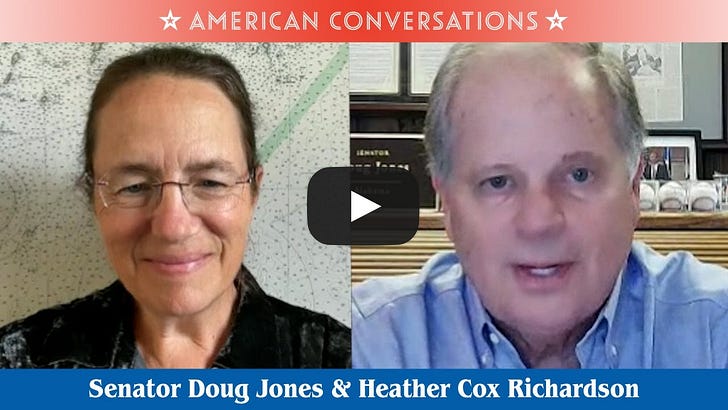
Doug Jones went on to serve as a Senator from Alabama from 2018 to 2021. On this anniversary of the bombing, Senator Jones talked about the events of that day, justice, healing, and what lessons today’s Americans can take from the bombing and its aftermath.
Throughout the last few years I’ve emphasized to my teammates at Citizen University that we must not let everything in civic life get nationalized — that we must help our network of CU catalysts practice humanity and civic power and civic character in the local relational contexts of the places where they live.
But I know that is increasingly difficult. The assassination of Charlie Kirk this week was terrible in its own right — no one should be murdered for their views and political action. It is dangerous also because it may now accelerate the nationalizing and literal weaponizing of our politics, the dehumanizing of opponents, the hardening of everyone’s hearts.
So, with my team today and now with this wider ecosystem, I do come back to my original emphasis, with a variation. We can and must help people “live like a citizen” wherever they live — to practice how to see, feel, hear, serve the people around them in their full complex humanity. But more than ever now, to sense the pain around them. And neither we nor they can be preferential about our pain-sensing. A kind of pain has led millions of people to follow Kirk. A kind of pain has led someone to take Kirk’s life. A kind of pain is pulsing through cities where people fear their own government and their neighbors. There are so many other kinds of pain making our politics tumultuous in every quarter, shaping how people show up or don’t in the lives of their towns and neighborhoods.
The “habits of heart and mind” that inform our programs and projects at CU — that keep a community from disintegrating — are not just about the sensing. They are also about inviting each other to convert what we sense and feel into what we do and choose: build or destroy, heal or scorn. There are ways to relieve pain that involve inflicting it on others, and there are ways to relieve pain that involve solving problems with others, making sense of things together, and in the process making each other more wholly human.
That choice is not just for the day after a headline-making act of political violence, and not just on 9/11 + 24. It’s not only about partisan or ideological divides. Making that choice doesn’t require the permission of some prominent leader or influencer. It doesn’t require me or you to validate views we don’t like. Nor does it invite us to be the savior of people we think are benighted, nor imply that we have surrendered naively to them. We recommit to humanizing habits to save ourselves, our own civic souls, and simply out of the other deep principle we teach at CU — that society becomes how you behave.
I know it’s hard, and it’s probably going to get harder. We’ve got to keep at it, with heart and courage. We truly have no choice. If we are to live together we must choose to live, together. And to show others that it is possible.
Aaron S. Kesselheim is a primary care physician, lawyer, and professor of medicine at Harvard with expertise in pharmacoepidemiology and pharmacoeconomics.
Pharmaceutical ads in the United States are annoying. Absurd. And almost uniquely American.
In fact, only one other high-income country in the entire world—New Zealand—allows prescription drug companies to advertise directly to consumers. Everyone else has decided the downsides aren’t worth it. So why hasn’t the U.S. stopped them?
From the get-go, RFK Jr. has named eliminating pharmaceutical ads as one of his goals. And believe it or not, I’m with him on this one. (Gasp!) But can the administration actually take action? They think they can. Yesterday, a new executive memo and an accompanying FDA press release claimed to step up enforcement against drug ads.
Here are answers to the top 9 questions.
Why are prescription drug ads even allowed here? The story goes back to 1938, when Congress passed the Food, Drug, and Cosmetic Act. For decades afterward, most assumed this law made it illegal to advertise prescription drugs directly to consumers. Why? Because no advertisement could possibly provide a full and complete description of a drug’s benefits and risks. Thus, ads would inevitably misbrand medicines.
But in the 1980s, the FDA decided that wasn’t exactly true. The agency concluded that drug ads were legal as long as they included a “brief summary” of the FDA-approved drug label. That’s when glossy magazine ads took off—big splashy photos on one page, with tiny print summarizing risks on the next.
In 1997, the FDA made another pivotal change: on TV and radio, drug makers no longer needed the entire summary. Instead, they could provide a “major statement” of key risks. That’s the moment the modern era of pharmaceutical commercials began.
Do drug ads make medicines more expensive? Not directly. Brand-name drugs are expensive in the U.S. because we allow manufacturers to set whatever price they want. Unlike in most other countries, the government does not negotiate those prices up front. Then, once a drug is on the market, companies can hike prices at will.
But ads do shape what drugs patients ask for, and those tend to be the most expensive ones.
Generic manufacturers rarely advertise because they face what economists call the “free rider” problem. Multiple companies make the same generic pill. If you ask your doctor for a generic, your pharmacy will give you whichever version is in stock, not a specific brand. That means an ad from one generic company might boost sales for its competitors, too. Why bother?
As a result, nearly all drug ads are for costly brand-name drugs. That means patients who respond to ads often end up paying for these expensive drugs, even when a cheaper, equally effective generic or even a non-drug treatment exists.
Have the number of ads increased over time? Yes, particularly to patients (or consumers) compared to physicians. One study found that between 1997 and 2016, direct-to-consumer ad spending jumped from $2.1 billion to $9.6 billion. Today, drug manufacturers pour roughly $6 billion a year into these ads, most of it concentrated on top-selling brand-name drugs—and not necessarily the best brand-name drugs, either. (continued on page 2 or here)
Figure from Medical Marketing in the United States, 1997-2016 in JAMA. Source here. Another study found that fewer than one-third of the most common drugs featured in direct-to-consumer television advertising were rated as having high added value for patients.
Why do ads spend half the time listing side effects? It’s required. When the FDA opened the door to TV ads in the late 1990s, they did so with strings attached. Companies had to include a “major statement” of key risks.
On top of that, drug ads must provide “fair balance,” meaning the positives and negatives have to both be presented. In practice, this usually means the first half of the commercial shows people frolicking on beaches, while the second half is a dizzying recital of warnings.
Are drug ads misleading? The short answer: sometimes.
The FDA’s Office of Prescription Drug Promotion (OPDP) is supposed to make sure ads are accurate, not misleading, and fairly balanced. But here’s the catch: companies don’t have to submit ads for approval before airing them. When OPDP does find problematic ads, it’s often months after they’ve gone public.
And what counts as “misleading” isn’t always straightforward. Take an ad that promotes a new sleep medicine that helps people “fall asleep quickly.” That sounds impressive until you learn that in the trial leading to the drug’s FDA approval, patients taking the drug fell asleep within 30 minutes, while people taking placebo fell asleep within 45 minutes. Not a big difference. Is the ad technically misleading? Hard to say.
Psychology complicates things further. Studies show that when drug risks are read aloud while soothing images play in the background, viewers are distracted from the serious information. The ad meets the rules, but the impact on patients is another story.
Do these ads actually help patients? This is a complicated question.
On one hand, drug ads increase prescribing of the featured medicines. One can imagine a case in which that is good. Patients who might otherwise suffer in silence, for example with erectile dysfunction or depression, might be encouraged to start conversations with their doctors. In theory, ads can empower people to seek treatment for stigmatized conditions.
On the other hand, ads can drive “over-prescribing.” If a patient walks into the doctor’s office and asks for a drug by name, studies show they’re more likely to get it, even if a different approach might have been better. This has raised concerns about ads fueling unnecessary or inappropriate use, especially for conditions like adult ADHD, dry eyes, or adjustment disorder.
The truth is, drug ads are a mixed bag. They can open doors to care but likely, more often than not, encourage expensive and even unnecessary prescriptions.
Could the U.S. ever ban these ads? Banning drug ads would be hard to imagine in the U.S. for multiple reasons.
The biggest is the First Amendment. A ban on drug ads would have to be defended in court, since pharmaceutical companies would immediately sue to overturn the ban. But the Supreme Court has interpreted the First Amendment’s protection of freedom of speech to cover commercial entities, even though businesses are not people. Unfortunately, changing the courts’ current perspectives on commercial speech is hard to envision short of a Constitutional amendment that clarified that corporations are not people and do not deserve similar speech protections.
So, if not a ban—and in the absence of a voluntary agreement by the drug companies to stop advertising—the government could try to regulate drug ads more tightly. For example, the FDA could create rules about their content or where and when they can be shown. Online ads, in particular, may have features that make them prone to misinterpretation—for instance, how risk information is displayed or how distracting design elements (like autoplay videos or pop-ups) might affect understanding. The FDA could try to identify such situations and establish rules to address them. Congress could also provide more resources and authority to the FDA to spot problematic ads quickly and remove them from circulation.
Why hasn’t this been accomplished before? In one word: lobbying.
The pharmaceutical industry has the most powerful and well-resourced lobbying organization in Washington D.C. It has historically opposed any efforts that would restrict manufacturers’ ability to advertise broadly because, as noted above, drug ads help brand-name manufacturers make money. The industry has provided substantial funds over the years to many of the legislators and helped elect presidents who have defined the FDA’s agenda and funding.
So does this FDA proposal have teeth? The new directive sounds tough, but in practice it doesn’t have much bite. As with drug ads themselves, it is important to read the fine print!
Key steps included in the directive are:
Stricter enforcement: The FDA reportedly plans to issue about 100 cease-and-desist letters and “thousands” of warning letters about drug ads.
Closing a loophole: In their major statements of drug risks, TV and radio ads have long been allowed to list only the “most important” risks if they point viewers to a website or phone number for more details. The administration says this “adequate provision” rule isn’t sufficient and wants more risks spelled out directly in the ads, even if it makes them a little bit longer.
Expanding oversight: Regulators are being directed to pay closer attention to how drug ads appear on social media platforms.
The impact of these moves will likely be limited. Warning letters nearly always just result in the company withdrawing or adjusting the advertisement without any fines or additional penalties—oftentimes months after the ad has already been widely disseminated. With recent cuts to the personnel and budget at the FDA, consistent and aggressive oversight of social media will also be hard to sustain. The directive does not even try to provide details about the so-called expanded oversight, such as essential guidelines about what should and should not be permitted in social media advertising of drugs. Such details have been needed for many years (and still do)!
Bottom line Drug ads are a limited and inherently problematic way to inform people about prescription drugs. We need to do a much better job of empowering patients to get the medical care they need and to educate patients about the true benefits and risks of prescription drugs in an unbiased way.
Whether this ever changes will depend not just on one administration, but on how we as a country decide to balance corporate power, commercial speech, and the health of our citizens.




 Reload document
  Open in new tab