
Thanks to Mary M.

Thanks to Mary M.
Thanks to Mike C. for forwarding this.
Last month, Axios published “Off the rails,” a series taking you inside the end of Donald Trump’s presidency, from his election loss to the deadly Jan. 6 Capitol insurrection that triggered his second impeachment — and a Senate trial set to begin next week.
In this bonus edition, we take you back into those final weeks — to one long, unhinged night a week before Christmas, when an epic, profanity-soaked standoff played out with profound implications for the nation.
Four conspiracy theorists marched into the Oval Office. It was early evening on Friday, Dec. 18 — more than a month after the election had been declared for Joe Biden, and four days after the Electoral College met in every state to make it official.
“How the hell did Sidney get in the building?” White House senior adviser Eric Herschmann grumbled from the outer Oval Office as Sidney Powell and her entourage strutted by to visit the president.
President Trump’s private schedule hadn’t included appointments for Powell or the others: former national security adviser Michael Flynn, former Overstock.com CEO Patrick Byrne, and a little-known former Trump administration official, Emily Newman. But they’d come to convince Trump that he had the power to take extreme measures to keep fighting.
As Powell and the others entered the Oval Office that evening, Herschmann — a wealthy business executive and former partner at Kasowitz Benson & Torres who’d been pulled out of quasi-retirement to advise Trump — quietly slipped in behind them.
The hours to come would pit the insurgent conspiracists against a handful of White House lawyers and advisers determined to keep the president from giving in to temptation to invoke emergency national security powers, seize voting machines and disable the primary levers of American democracy.
Herschmann took a seat in a yellow chair close to the doorway. Powell, Flynn, Newman and Byrne sat in a row before the Resolute Desk, facing the president.
For weeks now, ever since Rudy Giuliani had commandeered Trump’s floundering campaign to overturn the election, outsiders had been coming out of the woodwork to feed the president wild allegations of voter fraud based on highly dubious sources.
Trump was no longer focused on any semblance of a governing agenda, instead spending his days taking phone calls and meetings from anyone armed with conspiracy theories about the election. For the White House staff, it was an unending sea of garbage churned up by the bottom feeders.
Powell began this meeting with the same baseless claim that now has her facing a $1.3 billion defamation lawsuit: She told the president thatDominion Voting Systems had rigged their machines to flip votes from Trump to Biden and that it was part of an international communist plot to steal the election for the Democrats.
| February 8, 2021 | 11am (PT) / 2pm (ET) Join us as we welcome NBC and MSNBC Medical Contributor Dr. Vin Gupta, Assistant Professor, Institute for Health Metrics and Evaluation, UW Medicine along with Dr. Dale Reisner, Medical Director (OB/GYN Quality and Safety) at Swedish Health Services. This discussion will focus on the current state of knowledge on the long-term impacts of COVID-19 infection, provide guidance on how our health system must support individuals with this condition, and detail other considerations as our country navigates our way out of this crisis. We have been approved for 1 BCPA CE as part of this Community Conversation [Free for Members and $25 for Non-Members]. This live event is free and open to the public…it will also be recorded and available on our website (and YouTube Channel). OBJECTIVES: 1. Understand the clinical characteristics of long COVID-19 syndrome. 2. Understand the potential medical needs of this patient population. 3. Discuss the importance of vaccination and continued mitigation efforts for this patient population. |
Thanks to Sybil-Ann
Thanks to Sybil-Ann
Nine Important Facts to Remember as We Grow Older:
#9 Death is the number 1 killer in the world.
#8 Life is sexually transmitted.
#7 Good health is merely the slowest possible rate at which one can die
#6 Men have two motivations: hunger and hanky-panky, and they can’t tell them apart. If you see a gleam in his eyes, make him a sandwich.
#5 Give a person a fish and you feed them for a day. Teach a person to use the Internet and they won’t bother you for weeks, months, maybe years.
#4 Health nuts are going to feel stupid someday, lying in the hospital, dying of nothing
#3 All of us could take a lesson from the weather. It pays no attention to criticism.
#2 In the 60’s, people took LSD to make the world weird. Now the world is weird, and people take Prozac to make it normal
#1 Life is like a jar of jalapeño peppers. What you do today may be a burning issue tomorrow
Mike C. sent this link to a fascinating NYT op-ed: CLICK HERE to view.
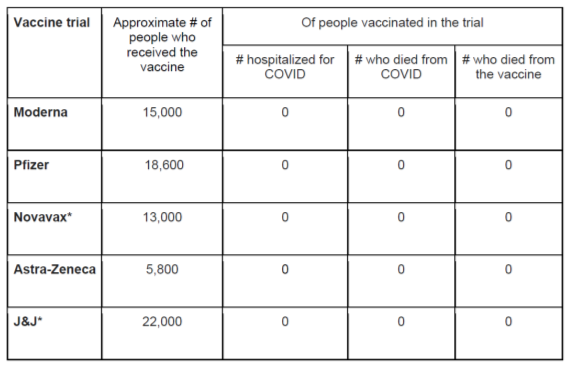
Ed Note: Ashish K Jha, MD, MPH from Harvard has reminded us in this tweet two days ago that all vaccines so far show very impressive results in preventing hospitalizations and deaths.
Am often asked about different vaccines and their efficacy Each trials tracks, reports efficacy differently Currently, we have preliminary results for Novavax and J&J But what numbers matter? What should you look for? Here’s one set of data to track. In a simple table
Thanks to Sally S.
A cold seat in a public restroom is unpleasant. A warm seat is worse.
Apparently when RSVP’ing to a wedding invitation, “Maybe next time” isn’t the correct response.
Don’t irritate old people. The older we get the less “life in prison” is a deterrent.
Have you ever listened to someone for a minute and thought, “Their cornbread ain’t done in the middle.”
Aliens probably fly by earth and lock their doors.
You will hit every cone on the highway before I let you merge in front of me because you saw that sign 2 miles ago like I did.
I asked my wife if I was the only one she had been with. She said yes, all the others were nines and tens…
I really don’t mind getting older, but my body is taking it badly.
It turns out that being an adult is mostly just googling how to do stuff.
I miss the 90’s, when bread was still good for you and no one knew what kale was.
Do you ever get up in the morning, look in the mirror and think, “That can’t be accurate.”
I want to be 14 again and ruin my life differently. I have new ideas.
As I watch this generation try to rewrite our history, one thing I’m sure of… it will be misspelled and have no punctuation.
I thought getting old would take longer.
Confuse your doctor by putting on rubber gloves at the same time he does.
My wife asked me to take her to one of those restaurants where they make food right in front of you. I took her to Subway. That’s when the fight started.
Me: Sobbing my heart out, “I can’t see you anymore… I’m not going to let you hurt me again.” Trainer: “It was one sit-up. You did one sit-up.”
Picked up a hitchhiker. He asked if I wasn’t afraid he might be a serial killer? I told him the odds of two serial killers being in the same car were extremely unlikely.
I went line dancing last night. OK, it was a roadside sobriety test… same thing.
By Tim Burgess Special to The Times
The tents, dilapidated vehicles and piles of trash you see in almost every Seattle neighborhood have become an enduring fixture. So has the human suffering.
We should quickly prioritize addressing these tent encampments and follow the lead of other cities that have successfully tackled this issue. Since 2015, when the mayor declared a homelessness emergency, we have spent hundreds of millions of taxpayer dollars — and there are success stories to tell — but, tragically, there is no comprehensive plan to remove these illegal tent encampments or to help those living in them. Not now. Not any time this year or next. Not in five years. They are essentially permanent.
That’s because the Seattle City Council’s preferred approach has been tolerance and accommodation, evidenced by its elimination last fall, despite Mayor Jenny Durkan’s strong objection, of the navigation teams — outreach workers paired with police officers — that successfully nudged people in encampments to accept shelter and social services.
The City Council’s laissez faire approach furthers the terrible damage of substance-abuse and mental-health disorders for the majority of encampment dwellers. It’s also an approach that denies the public access to parks, sidewalks and greenspaces. It enables criminal behavior that harms neighbors, businesses and other campers. It creates piles of trash and unsanitary conditions. It harms our tourism and hospitality industry, a key jobs-producing component of Seattle’s eventual economic recovery. It’s appallingly misguided, worsened by the council’s convoluted and confusing rules and regulations designed to prevent, or at least delay, the removal of any encampment.
There is a much better, more humane way forward.
Let’s implement a specific plan that is both compassionate in meeting urgent human needs and fulfills city government’s public health and safety obligations. A plan designed to remove encampments and prevent their return, to restore access to our parks and public spaces for everyone’s enjoyment, to help campers by providing enhanced substance-abuse and mental-health services. A plan that no longer ignores or excuses the criminal behavior — assault, burglary of homes, businesses and cars, arson, theft — of some unsheltered individuals that has created chaos in parts of the city and shattered confidence in the city government.
Look at the facts.
Our parks, sidewalks, streets, freeway rights of way and greenspaces have become “home” to an estimated 3,738 individuals, almost one-half (46%) of Seattle’s total homeless population, according to the latest (January 2020) point-in-time count. Most of the unsheltered population reports living with mental-health or substance-abuse challenges, often both.
It’s clear we need a new, more purposeful approach or the encampments will continue to grow in number. And we should move quickly to prepare for better weather and the decline of the COVID-19 pandemic when park usage will soar.
The plan should meet the medical needs of campers — a major cause of their unsheltered living — by providing truly on-demand treatment for those with substance-abuse disorder or mental-health challenges. “On demand” means available the moment someone acknowledges a need for help: not next week or next month, not placement on a waiting list, but right now. Treatment services — both inpatient and outpatient options — should follow the science of what works best based on rigorous, independent, published evaluations.
The plan should recognize that these services won’t provide a quick cure, yet a long-term commitment to a patient’s recovery is essential. These services should use whatever state and county government funding is available but recognize that repurposed city funding will be needed to serve the target population effectively. We should stop waiting for another level of government to step up; the cost of inaction is devastating.
The plan should speed up Mayor Durkan’s surge strategy, including Monday’s announcement of a public-private partnership, to help accelerate the creation of more enhanced shelter capacity, tiny houses and rented hotel rooms to quickly move unsheltered people into safer, cleaner, warmer places.
Importantly, the plan must require written service plans for each unsheltered individual, a key success element endorsed by national experts and a dramatic shift from Seattle’s highly informal ad hoc outreach approach. The city recently funded additional outreach services but did not specify performance outcomes, allowing a dozen or so nonprofit organizations to use their own methodologies and success criteria. The plan should divide the city into service regions so outreach teams have a specific geographic area of responsibility, a change that will significantly increase accountability.
The plan should use a focused deterrence approach to criminal behavior, employing a range of interventions including arrest and prosecution, if necessary. This is not, as some claim, “the criminalization of homelessness.” It’s a considered response to specific people who are engaged in destructive, ongoing acts of violence or persistent criminal behaviors that significantly harm others, including other unsheltered persons. It is behavior focused, not homelessness focused.
The plan should recommit city government to the new but not yet operational Regional Homeless Authority, acknowledging that homelessness and encampments are a regional problem that requires a shared response with high accountability measures and regular public progress reports.
The plan should require either acceptance of services — such as shelter, temporary housing and treatment services — or removal, strongly encouraging people to choose but not allowing continued camping.
And, finally, the plan should acknowledge the importance of permanent, low barrier supportive housing — a “housing first” approach — because so many of the unsheltered are chronically homeless with serious addiction and mental-health needs. To reestablish their lives, they need a safe, warm and welcoming place with supportive health and social services.
Delivered on Tuesday mornings, this email brings you the best in Opinion, from editorials to letters to the editor, and a preview of what lies ahead.Sign up
This new plan will be expensive — primarily because of the need to significantly increase access to treatment services — but it’s doable with a reallocation of existing city funds. It will require a fierce determination to achieve desired outcomes and to resist the many competing interests that have crippled the city’s ability to successfully address the encampments.
Is this all a pie-in-the-sky fantasy? Could we actually serve our unsheltered and chronically homeless population better? The answer is absolutely “yes” because other cities have already done it. Look at Bakersfield-Kern County, California. Or Bergen County, New Jersey. Or Abilene, Texas. Each of these jurisdictions — along with more than 75 others across the country — joined Community Solutions, a national nonprofit organization, and rigorously followed their step-by-step process to reduce the unsheltered homeless population. It is a successful model Seattle should follow, and quickly.
A plan like this can eliminate unsafe encampments and start hundreds of individuals on a path to safe, stable and healthier lives. Wouldn’t that be worth it?Tim Burgess is a former Seattle City Council member and interim mayor.
If you’re a data geek, you may enjoy this update sent by Sue P.
Dear friends and neighbors,
Right now, a lot is happening in the state Legislature. I wanted to let you know some of the actions we are taking to address the challenges facing people in the 43rd District and across Washington state.
To provide your point of view or to ask questions, please feel free to reach out to my office by emailing my legislative assistant, Daniel Lugo, at Daniel.Lugo@leg.wa.gov) or calling 206-905-6681.
Even before the COVID-19 pandemic, the child care system was in crisis. Now it’s in danger of collapse. Already, it is already costing Washington businesses more than $2 billion a year, and working parents are forgoing $14 billion a year in lost wages due to the lack of access to affordable child care. As a result, large numbers of parents are leaving the workforce or reducing hours and take-home pay. It’s clear that Washington’s child care market is broken and too many children and families are bearing the consequences.
But we know how to proceed! State Representative Tana Senn, Senator Claire Wilson and I are leading the charge for the Fair Start for Kids Act (House Bill 1277). Our proposal is a multi-faceted approach to address the child care crisis, help the economy recover, and promote social and racial equity. The bill aims to make child care and early learning more affordable for families, stabilize and support the diverse child care workforce, and expand child care and early learning access to many more kids.
This past week, parents, employers, and child care providers testified in support of the bill in the Children, Youth & Families Committee. They teleconferenced into the committee from their homes and workplaces to share their moving stories. You can watch the full public hearing here. This year, we have a window of opportunity to take action for our kids, our jobs, and our future!
Child care is incredibly important to employers and our overall economy. After all, why do employees need child care? To go to work! In addition, so many people say that “early learning is the best investment we can make.” We need to turn that rhetoric into reality in the state budget – and provide funding with new progressive tax revenue, with a Fair Share Contribution from corporations doing well even in this current economy!
Fair Share for Child Care!
Thanks to Paul T.
Thanks to Mary M.
Find out what’s happening on the Pine Ridge Indian Reservation; Medic 1; the Medical Examiner’s office; and a new drug. It’s a little techie, but may be of interest to some. Click this link then hit the play button to watch: http://bit.ly/3orMtAv
A message from Congressman Adam Smith: |
| Home Issues Legislation Services |
Facebook Live/Zoom Town Hall Alert I will be hosting a Town Hall event on Facebook Live and Zoom on Saturday, January 30th at 10:00 AM PT (1:00PM ET) to answer questions from constituents and discuss ongoing current events, COVID-19 relief, priorities in the new Congress and with the Biden-Harris Administration, recent legislative efforts, and more. If you would like to ask a question for this Town Hall, you can post it in the comments here or ask one live in the chat during the event. To RSVP and join the Facebook Live, please use the Facebook link here or below. https://www.facebook.com/events/460406021786584/ If you would like to join through Zoom or by phone, please RSVP here or below: https://us02web.zoom.us/webinar/register/WN_cIpuiG7rTaqAXAAdQP1i9w If you have friends or family who may not have received this email, but would benefit from our discussion, please pass on this information. You can also stay up to date by visiting my Twitter, Facebook, and website. I look forward to speaking soon.Sincerely,Adam |
| Washington DC Office 2264 Rayburn HOB Washington, DC 20515 Phone: (202) 225-8901 101 Evergreen Building 15 S. Grady Way Renton, WA 98057 Phone: (425) 793-5180 Fax: (425) 793-5181 |
| Unsubscribe |
Topic: The Election Reform Agenda: A Deep Dive into HR 1
Description:
HR1, the For the People Act, is a sweeping bill that aims to strengthen
American democracy. Included in the bill are reforms to election administration,
campaign finance, gerrymandering, and voting rights. HR1
passed the House in 2019, and is likely to be brought upn in Contress again
this year.
What exactly is included in HR1 and what are the arguments of its
supporters and detractors? Join u s for a deep dive into four components of
this historic legislation. Each panel brings together advocates, critics, and
academics to descriibe the specific reforms under consideration.
These panels are co-sponsored by the Standford-MIT Healthy Elections Project and
the Stanford University Center on Democracy, Development and the Rule of Law.
There will be four sessions:
Part 1: Election Administration
Monday, February 1, 2021, 12:00 – 1:15 pm PT
Part 2: Voting Rights
Tuesday, February 2, 2021, 12:00 – 1:15 pm PT
Part 3: Gerrymandering
Monday, February 8, 2021, 12:00 – 1:15 pm PT, and
Part 4: Campaign Finance
Tuesday, February 9, 2021, 12:00 – 1:15 pm PT
To register, click on this link (which will open a new window in your browser so you may have to switch to that screen): https://stanford.zoom.us/webinar/register/WN_1wg7McorSjmmAmRlxZ3nlg
Sent at the request of Put Barber by Mary Jane Francis.
Contact Put for further information or questions at putnam.barber@gmail.com.
We’ve just completed our first event with Secretary of State Kim Wyman. Now plan to join Washington’s Attorney General Bob Ferguson for a discussion of his views on the Biden Administration’s Impact on Washington and legal issues involving the Attorney General’s Office.
If you have a particular topic of interest or a question you would like the Attorney General to address, please send it to Jim Sanders at jimsanders1947@gmail.com.
Ed note: About one-third of the US population has been infected with the SARS-CoV-2 virus so far–at the expense of 400,000 lost lives. This podcast from the NYT Daily gives the best update I’ve found. What to expect next?? Click here to listen: http://nyti.ms/3qPb2sO
From the NYT: The number of new coronavirus cases in the United States is falling, but does that mean the country has turned a corner in the pandemic?
There is an awful reality behind the decline: As the virus has run through the U.S., it has infected a third of the population, according to most epidemiological models, and killed over 400,000 people in the country.
And the downward trajectory may not last, as the threat posed by new virus variants looms large.
Today, we discuss the latest in the quest to stamp out the coronavirus.

Amanda Gorman with James Corden – an interview. Thanks to Mary Jane F.


![[]](https://i0.wp.com/lh3.googleusercontent.com/-onI0UZNfZiU/WCZARiqgvgI/AAAAAAAJCy4/IgVOarA_Nuw/original3_thumb.jpg?resize=530%2C530&ssl=1)


