Located in the south of Colombia, the road between Mocoa and San Francisco in the department of Putumayo, is one of the most dangerous roads in the world. The road was built in 1930 and zigzags the Andean mountain range. There have been numerous deaths from cars falling off.
The road is 69.7km long, going through the Valley of Sibundoy. It’s known as Trampolín del Diablo (Devil’s trampoline), Adiós mi vida (Bye bye my life) or Trampolín de la Muerte (Death’s trampoline). (Thanks to Donna D!)
Posted inTransportation|Comments Off on Built in 1930 Trampolín del Diablo zigzags the Andes
To find out, go to https://info.kingcounty.gov/kcelections/vote/myvoterinfo.aspx and fill in any three of the four options: First Name:(As it appears on your voter registration card)Last name:(As it appears on your voter registration card)Date of Birth:Month (two digits) Day: (two digits)Year: (four digits)House or Building Number: Put in on the the street number address – generally 725. Do not include your apartment number. This should take you to the “MY VOTER INFORMATION”.Then click on “Track my Ballot”. You should then get a series of steps (with a green spot connected by a green line above) which say: Ballot sent Ballot Delivered Mailed Back Ballot Received Signature Ballot Counted verification If your ballot has been counted you should see: Congratulations! Your ballot has been counted.
Ed note: I’ve yet to read his book, but I suspect a lot of folks would agree with Dr. Dychwold’s research on aging and retirement as outlined in this article.
I’ve come to realize that I’d like to be useful more than youthful.
When someone retires, three substantial changes take place, said Ken Dychtwald, psychologist, gerontologist and founder and chief executive of Age Wave, a consulting and research company.
“They struggle with their identity, relationships and activity,” he said. “Some people feel unsettled, anxious or even bored, but eventually they realize that relationships, wellness and purpose really matter — perhaps more than ever.”
In his new book, his 17th, “What Retirees Want: A Holistic View of Life’s Third Age,” Dr. Dychtwald and his co-author, Robert Morison, parse how boomers are redefining retirement.
For this book, the authors surveyed more than 100,000 boomers, exploring facets of retirement — family, financial security, health, housing, leisure, philanthropy, work and happiness.
I spoke with Dr. Dychtwald about the book, the authors’ conclusions and also about his personal views of retirement. The highlights of our conversation are below and have been edited and condensed.
How have your views about retirement changed because of coronavirus and turning 70 this year?
I’ve been talking about retirement for 45 years, and my views are transforming. That’s partly sparked by Covid-19 and partly by turning 70, and also by having studied so many successful and unsuccessful retirees over the past half century.
Now let me unpack that. When I was getting started in this field, in the 1970s, we were inclined to think of retirement as kind of a short wind-down period, following a life of hard work. Back then, when people managed to get to the end of their work life, it was kind of a triumph. There was generally the view that retirement was a mark of success, and the earlier one did it, the more successful they must be.
It used to be that in retirement people sought to do things that they always liked, but didn’t have time for during their working years, like taking an extended vacation, playing more golf, socializing with friends, or reading some good books. That is how I thought about it, too.
That changed for me when I realized that retirement was getting longer — and longer. In addition, our studies were showing that many retirees were feeling bored and irrelevant, for decades. And I also began to notice that what was emerging was that some of the most successful role models for me weren’t winding it up when they turned 65. In fact, they were reinventing themselves and starting charities or organizations, or staying longer with their companies — with many even doing their best work.
I decided in my later years it was not going to be turn out the lights and devote myself to playing 24/7. I’ve come to see this evolving stage of life like a portfolio, and I now have the freedom and self-awareness to change and reprioritize my mix of activities. I view it as having a better balance between quality time with my family, work, play, continued learning and volunteering.
The pandemic this year has given many of us an enormous appreciation for the preciousness of life. I’ve come to realize that I’d like to be useful more than youthful.
If 2020 was a math word-problem: If you’re going down a river at 2 MPH and your canoe loses a wheel, how much pancake mix would you need to re-shingle your roof? (Thanks Mary M. for enlarging the message of this comic strip!)
Posted inHumor|Comments Off on What’s really scary!
A secret basement. A front-yard mailbox. A museum of museums. The show goes on, in unconventional ways. by Margo Vansynghel & Agueda Pacheco Flores. For the full article in Crosscut, please click here.
Artist Tyna Ontko attaches her hand-carved wooden art piece to Sun Spot, a pocket-sized white-box gallery founded by local artist Paul Nelson.
For the cultural sector, the bad news isn’t exactly news. More than seven months into the pandemic, things are looking rough. Many art workers are still unemployed and, without more support, some fear a slew of indie art spaces, music venues and museums might shutter forever.
But there’s also a glimmer of good news. Proving that creativity can flourish in the face of adversity, at least six new art spaces have opened across King County in recent months, despite and in some cases inspired by COVID-19 closures. From a long-awaited, 8,000-square-foot museum on Capitol Hill to what is perhaps the tiniest art space in King County, here are six new exhibition spaces — several of which upend the idea of a traditional gallery — where the art show goes on, despite the pandemic.
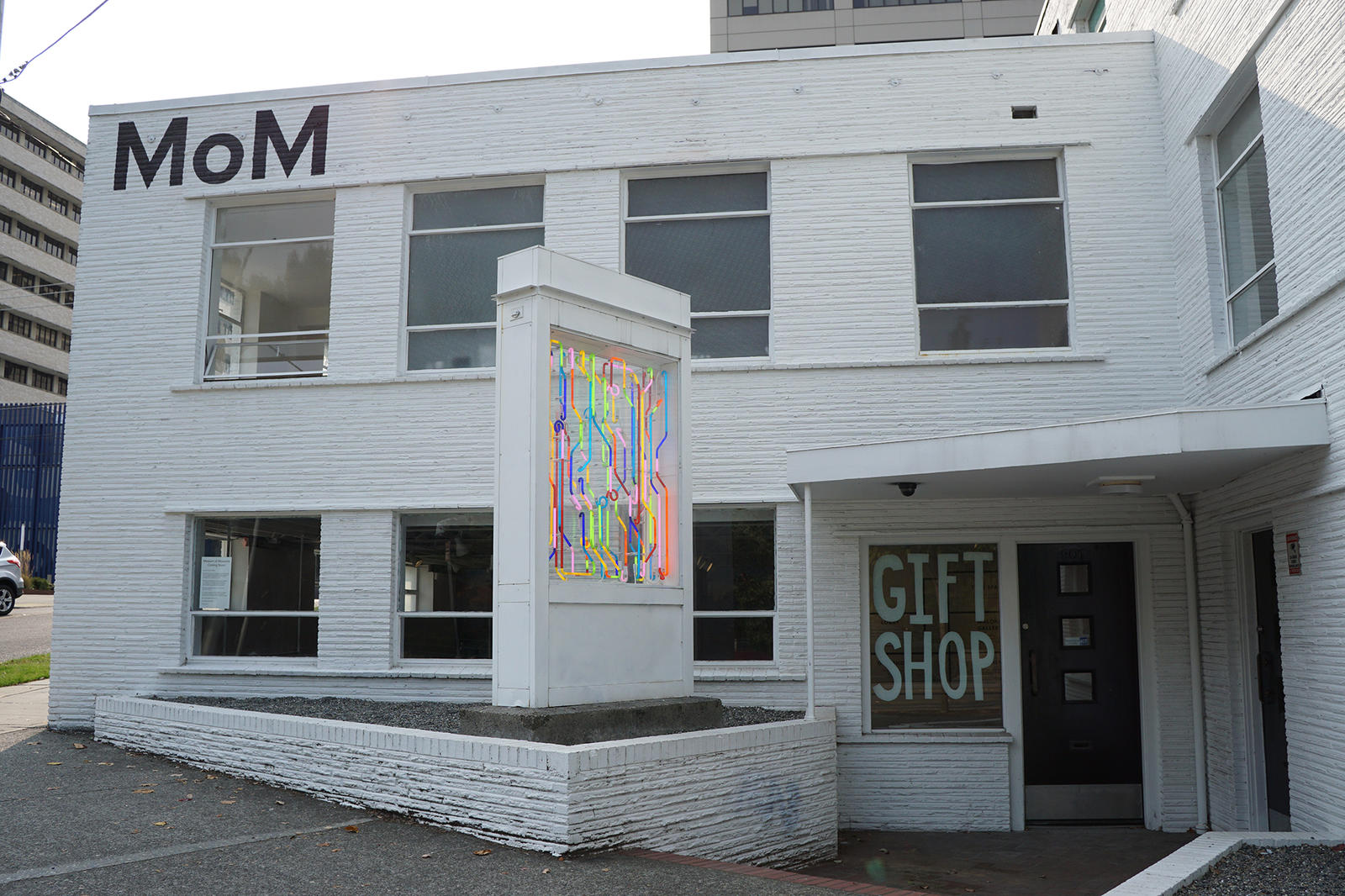
Seattle’s new Museum of Museums is located in a former medical office building owned by the nonprofit Swedish Health Services. It took arts entrepreneur Greg Lundgren more than a year to renovate the building’s 8,000 square feet.
Seattle’s new Museum of Museums is located in a former medical office building owned by the nonprofit Swedish Health Services. It took arts entrepreneur Greg Lundgren more than a year to renovate the building’s 8,000 square feet.
The former medical office
“I’m totally stressed,” says arts entrepreneur and curator Greg Lundgren, as he pets a stuffed toy (panda body, giraffe head) displayed in the gift shop of Seattle’s soon-to-open Museum of Museums. He pauses. “But it’s not my first rodeo.”
Lundgren’s rodeo usually goes like this: Find an empty property slated for future development or otherwise languishing, fix it up and reopen it as an innovative space for local art. But transforming a derelict midcentury medical office into a contemporary art museum amid a pandemic? That’s next level, even for Lundgren.
The museum — with three floors of galleries, a gift shop, permanent outdoor art and a four-seat theater — should have opened a year ago. Lundgren signed a lease on the expansive space at the border of Capitol Hill and First Hill in June 2019. But he soon hit a serious permitting snafu that dragged on for months. And then, you guessed it: the pandemic. Next: Look, don’t touch: Seattle museums reopen at last
“If there were a giant earthquake it would not surprise me,” Lundgren says dryly, as he gives me a tour of the space. Artworks for the inaugural show, Goodwitch/Badwitch (curated by Bri “The Hoodwitch” Luna and Lundgren), lean against walls, awaiting installation.
Upstairs, an immersive, candy-colored installation by Neonsaltwater and Brian Sanchez is still in progress; for now a palm tree shimmers through a sheet of hot-pink frosted glass. Downstairs, selfie lovers can bask in the fully floral bathroom by artist Elisa Maelen. In the gift shop, bathing, bare-breasted “Bigfeet” creatures in local painter Crystal Barbre’s 20-foot-long mural await eventual visitors. Although the pop-up show Mask Parade is already open on weekends to the public, the museum fully opens (at 25% capacity and by appointment) to members later this month, and in November to the general public. If all goes right, that is.
“We’re all charting new territory,” Lundgren says. “I feel like we have machetes and we’re just going through the jungle.”
Others might have given up, turned around and gone home. Not Lundgren. His conviction that Seattle is both artistically and monetarily rich — and that he can foster a stronger relationship between artists and collectors to avoid a creative brain drain — keeps him going.
In the stairwell at MoM, a black decal on a rare bare wall encapsulates Lundgren’s point: “There is no version of a great city with a declining artist population.”
It’s been a long time since America has thought very much about trustbusting. The phrase still calls to mind a grinning, cartoon Teddy Roosevelt, swinging his big stick at Standard Oil.
But as of this month, trustbusting is officially back on the table. The quarry this time isn’t Big Oil, Big Railroads or Big Steel, but Big Tech — including our homegrown giant, Amazon. On Oct. 6, the House Judiciary Committee’s Antitrust Subcommittee released a report on competition in the digital economy, including a suite of recommendations to revive antitrust enforcement and strengthen antitrust law. It was the culmination of a more than 16-month-long investigation into the market dominance and business practices of Apple, Amazon, Google and Facebook “to determine how their power affects our economy and our democracy.” Just this week, the Justice Department followed up with an antitrust lawsuit against Google.
This is the introduction to a series on anti-trust and Amazonat crosscut.com
Some of today’s practices recall that earlier era of trusts, cartels and monopoly power. In the late 19th and early 20th centuries, John D. Rockefeller Sr. strong-armed merchants into selling only Standard Oil. Today, Google and Apple use exclusionary contracts to prevent suppliers, distributors and customers from doing business with their competitors. Not only did Standard Oil receive deep concessions on shipping costs from colluding railroads, it got intelligence on rival oil refiners’ prices, enabling the company to go lower. Today, Amazon uses its god’s-eye view of the independent sellers on its platform to launch competing products. What Standard Oil did to the small refineries, undercutting them before gobbling them up, Amazon did to Diapers.com.
But today’s landscape is also different. Each of the four tech giants controls critical pieces of the infrastructure of the digital world where so many of us spend so much of our time and our money. Often they compete in marketplaces they themselves run, a fact that isn’t novel in itself (your favorite chain grocery store likely has a house brand) but which assumes new significance in the growing and hyperconcentrated world of e-commerce, where platforms shoulder little risk and collect information on individual sellers and customers in minute and exhaustive detail. Most of all, what is new is the extent to which we depend on these corporations, not just as consumers, but as humans, so that being mined for data becomes the price of admission to modern life. Issues of competition and antitrust blend with larger questions of privacy, access to information, the health of our public sphere and the future of our democracy.
That was the starting point for congressional scrutiny of Big Tech back in 2018. Facebook CEO Mark Zuckerberg was grilled by both Senate and House committees following the revelation that Cambridge Analytica, a political consulting firm with ties to the Trump campaign, harvested millions of Facebook users’ data to build psychological profiles of likely voters. Questioning ranged beyond privacy to Russian meddling in the 2016 presidential election, racial targeting, censorship, “fake news” — and monopoly power. Sen. Lindsey Graham, R-South Carolina, asked Zuckerberg if he thought Facebook was a monopoly. “It doesn’t feel that way to me,” he replied.
What should Joe Biden’s economic policy be if he wins (and Democrats take the Senate, so that he can actually pass legislation)? I’m pretty sure I know what his economists think he should do, but I’m not equally sure that everyone on his political team fully gets it, and I’m worried that the news media will experience sticker shock — that is, they may not be ready for the price tag on what he should and probably will propose.
So here’s what everyone should understand: Given the current and likely future state of the U.S. economy, it’s time to (a) spend a lot of money on the future and (b) not worry about where the money is coming from. For now, and for at least the next few years, large-scale deficit spending isn’t just OK, it’s the only responsible thing to do.
Today’s column will be about the economics; I’ll talk about the politics another day.
First things first: If Biden is inaugurated in January, he will inherit a nation still devastated by the coronavirus. Trump keeps saying that we’re “rounding the corner,” but the reality is that cases and hospitalizations are surging (and anyone expecting a lame-duck Trump administration to take effective action against the surge is living in a dream world.) And we won’t be able to have a full economic recovery as long as the pandemic is still raging.
What this means is that it will be crucial to provide another round of large-scale fiscal relief, especially aid to the unemployed and to cash-strapped state and local governments. The main purpose of this relief will be humanitarian — helping families pay the rent and keep food on the table, helping cities and towns avoid devastating cuts in essential services. But it will also help avoid a downward economic spiral, by heading off a potential collapse in consumer and local government spending.
The need for big spending will not, however, end with the pandemic. We also need to invest in our future. After years of public underspending, America desperately needs to upgrade its infrastructure. In particular, we should be investing heavily in the transition to an environmentally sustainable economy. And we should also do much more to help children grow up to be healthy, productive adults; America spends shamefully little on aid to families compared with other wealthy countries.
But how can we pay for all this investment? Bad question.
You sometimes hear people saying that the government should be run like a business. That’s a poor analogy in many ways. But for what it’s worth, think of what smart businesses do when they face great investment opportunities and have access to cheap capital: they raise a lot of money.
We’ve just seen that the U.S. government needs to invest large sums in the future. What about access to capital? The answer is that there’s a global savings glut — the sums individuals want to save persistently exceed the sums businesses are willing to invest. And this situation — private savings all dressed up with nowhere to go — translates into extremely low government borrowing costs. In February, before the coronavirus sent us into recession, the average interest rate on long-term inflation-protected U.S. bonds was minus 0.12 percent. Yes, it was less than zero.
Under these conditions it would actually be irresponsible for the federal government not to engage in large-scale borrowing to invest in the future.
But shouldn’t we be worrying about running up more government debt? No.
Posted inFinance|Comments Off on Why Biden Will Need to Spend Big
4. Students launch a hotline with jokes, stories and support for isolated seniorsBy dialing 1-877-JOY-4ALL (1-877-569-4255), callers can hear pre-recorded, continuously updated messages tailored for the elderly and the isolated. Read in CNN: https://apple.news/AFN6xcJ4uQt-LyJ6GYfWXTw
Posted inHealth|Comments Off on Resilience during the pandemic





 Reload document
  Open in new tab