Thanks Sybil-Ann!

Thanks Sybil-Ann!
A History Link Essay – posted in 2019 by Rita Cipalla. (Thanks to Ann M.)

Richard Beyer: People Waiting for the Interurban, 1978 cast aluminum sculpture.
A History Link Essay – posted in 2019 by Rita Cipalla
On June 17, 1978, a life-size, cast-aluminum sculpture depicting five adults, a child-in-arms, and a dog with a human face, all waiting for a trolley car, is dedicated at noon in Seattle’s Fremont neighborhood during the Fremont Fair. Situated on a triangular space at the corner of N 34th Street and Fremont Avenue N, close to the Fremont Bridge, the statue was created by local sculptor Richard S. Beyer (1925-2012), whose studio is on Lake Union. Beyer moved with his family to Seattle in 1957, initially intending to pursue an academic career. Part way through a Ph.D. program in economics at the University of Washington, he quit to become an artist. People Waiting for the Interurban is his first large-scale, multi-figure cast aluminum commission.
Tribute to a Bygone Era
Richard Beyer’s selection to create a piece of public art for Fremont came about by accident. The Fremont Im- provement Committee, of which Beyer was a member, was looking for ways to promote the neighborhood. The location for some kind of installation — a bench or signage, for example — had already been determined: A triangu- lar spot close to the Fremont Bridge which was slated for paving by the city. Beyer suggested an art competition. The committee approved the idea and the art contest moved forward, but it didn’t attract a single entry. Beyer, whose foundry was in Fremont and who had spent more than a decade trying to establish his art career, volun- teered to create a sculpture for the space. He went door to door seeking pledges. Once a few donations rolled in, he came up with several concepts.
His first idea was to create a statue depicting a ship rising out of the water to capitalize on Fremont’s location on a ship canal. He discarded that idea and proposed another, a cougar. That didn’t work out either. When he heard that pieces of the Interurban, the electric trolley line that operated between Seattle and Everett from 1910 to 1939, might be buried near the Fremont Bridge, he knew he had found the perfect subject matter.
by David Brooks in the NYT

Many of our best presidents have been underestimated. Truman was seen as the tool of a corrupt political machine. Eisenhower was supposedly a bumbling middlebrow. Grant was thought a taciturn simpleton. Even F.D.R. was once considered a lightweight feather duster.
I’ve been reading Joe Biden’s speeches and I’m beginning to think even his supporters are underestimating him.
He’s walking across treacherous cultural ground, confronting conflicts that are shredding the nation, and he’s mastering them with ease.
Biden is campaigning in a country that has lost faith in itself. Sixty-six percent of Americans believe our nation is in decline, according to a study from the Institute for Advanced Studies in Culture.
He’s also running in the middle of a political and cultural civil war. Eighty-two percent of Biden voters believe that “Donald Trump would like to gradually transform our country into a dictatorship,” according to that I.A.S.C. study. Ninety percent of Trump voters believe that the Democrats want to gradually turn America into a socialist country. According to a survey conducted by Braver Angels, a group that sponsors bipartisan conversations, 70 percent of Americans believe that if the “wrong” candidate wins, “America will not recover.”
Biden is campaigning in a land filled with fear, hatred and apocalyptic thinking. It would be so easy for him to reflect that fear and hate back to voters. That’s what Trump does.
But Biden is not doing that. Never in my life have I seen a candidate so confidently avoid wedge issues. Biden is instead running on the conviction that, despite it all, Americans deeply love their country, and viscerally long for its unity. He’s running with the knowledge that when you ask America about the greatest threats to our future, “political polarization and divisiveness” comes out No. 1.
It’s easy to say you’re for healing division. But here’s what Biden has actually done:
He’s de-ideologized this election. He’s made the campaign mostly about dealing with Covid-19. That’s a practical problem, not an ideological one. Conservatives and moderates don’t have to renounce their whole philosophy to vote for him. They can just say they’re voting for the person who can take care of this.
He’s separated politics from the culture war. Over the past generation, culture war issues have increasingly swallowed our politics. Trump has put this process into overdrive. He barely talks about policies. Instead, his every subject is really about why “our” identity group is better than “their” identity group.
So now the positions people take — on issues ranging from climate change to immigration — are determined by whether they see themselves as part of the rural white Christian conservative army or part of the urban multicultural secular progressive army. Policies are no longer debated discretely; they are just battles in one big, existential fight over who we are.
But Biden goes back to the New Deal, to an era of policymaking when there really wasn’t a polarized culture war. He sidesteps the Kulturkampf issues — which statues to take down — to simply talk about helping the middle class.
Biden has scrambled the upscale/downscale dynamic. The most important fissure in our politics is education levels. The Democratic Party’s greatest long-term challenge is that it might become the party of the highly credentialed college-educated class and let some future Republican rally a multiracial working-class coalition. Even Trump is now making surprising gains among Latino and Black men.
Biden has avoided all the little microaggressions that cultural elites use to show they are morally superior. Wokeness, for example, is partly about fighting oppression, but it’s also become a status symbol. It’s showing people that you are so intellectually evolved that you can use words like intersectionality, decolonizing and cultural appropriation. Political correctness is not just a means for the less privileged to set standards of behavior; it is also sometimes the way people with cultural power push others around.
Unlike, say, Hillary Clinton, Biden has a worldview and a manner that is both educated class and working class and defuses the divide.
Biden has avoided the stupid binaries about race. Donald Trump went to Mount Rushmore and made a speech essentially saying you can either believe in systemic racism or you can love America. Biden went to Gettysburg and argued that you can “honestly face systemic racism” and love America. He argued that you can believe in fighting racism and believe in law and order. His worldview is based on universal categories — the things we share — not identitarian ones — the ways we supposedly can’t understand each other across difference.
He’s done a good job reaching out to white evangelicals. Right now, many of them think he’s a godless socialist who will usher in a reign of anti-religious terror. In his campaign he’s done a pretty good job reaching out to those voters. His campaign has run ads on Christian radio and reached out aggressively to evangelical leaders. If he can allay their cultural fears (by making it clear he will not shut down Christian charitable groups) and win them over with working-class economic policies, he can create a long-term governing majority.
Seventy percent of Americans in that Braver Angels survey say America is facing permanent harm, but 70 percent also say the most important job after the election is to heal our enmity, to do the hard job of working with people whose views we find completely objectionable. This unity impulse is powerful in the populace, but it is deeply hidden.
Joe Biden knew it was there.
Thanks to Sybil-Ann!
• Venison for dinner again? Oh deer!
• How does Moses make tea? Hebrews it.
• England has no kidney bank, but it does have a Liverpool.
• I tried to catch some fog, but I mist.
• They told me I had type-A blood, but it was a Typo.
• I changed my iPod’s name to Titanic. It’s syncing now.
• Jokes about German sausage are the wurst.
• I know a guy who’s addicted to brake fluid, but he says he can stop any time.
• I stayed up all night to see where the sun went, and then it dawned on me.
• This girl said she recognized me from the vegetarian club, but I’d never met herbivore.
• When chemists die, they barium.
• I’m reading a book about anti-gravity. I just can’t put it down.
• I did a theatrical performance about puns. It was a play on words.
• I didn’t like my beard at first. Then it grew on me.
• Did you hear about the cross-eyed teacher who lost her job because she couldn’t control her pupils?
• When you get a bladder infection, urine trouble.
• Broken pencils are pointless.
• What do you call a dinosaur with an extensive vocabulary? A thesaurus.
• I dropped out of communism class because of lousy Marx.
• I got a job at a bakery because I kneaded dough.
• Velcro – what a rip off!
• Don’t worry about old age; it doesn’t last.
Located in the south of Colombia, the road between Mocoa and San Francisco in the department of Putumayo, is one of the most dangerous roads in the world. The road was built in 1930 and zigzags the Andean mountain range. There have been numerous deaths from cars falling off.
The road is 69.7km long, going through the Valley of Sibundoy. It’s known as Trampolín del Diablo (Devil’s trampoline), Adiós mi vida (Bye bye my life) or Trampolín de la Muerte (Death’s trampoline). (Thanks to Donna D!)


To find out, go to https://info.kingcounty.gov/kcelections/vote/myvoterinfo.aspx and fill in any three of the four options:
First Name:(As it appears on your voter registration card)Last name:(As it appears on your voter registration card)Date of Birth:Month (two digits) Day: (two digits)Year: (four digits)House or Building Number: Put in on the the street number address – generally 725. Do not include your apartment number.
This should take you to the “MY VOTER INFORMATION”.Then click on “Track my Ballot”.
You should then get a series of steps (with a green spot connected by a green line above) which say:
Ballot sent Ballot Delivered Mailed Back Ballot Received Signature Ballot Counted verification
If your ballot has been counted you should see:
Congratulations! Your ballot has been counted.
If you haven’t voted, what are you waiting for?
If you have questions contact Jim at jimsanders1947@gmail.com
By Kerry Hannon in the NYT
Ed note: I’ve yet to read his book, but I suspect a lot of folks would agree with Dr. Dychwold’s research on aging and retirement as outlined in this article.

When someone retires, three substantial changes take place, said Ken Dychtwald, psychologist, gerontologist and founder and chief executive of Age Wave, a consulting and research company.
“They struggle with their identity, relationships and activity,” he said. “Some people feel unsettled, anxious or even bored, but eventually they realize that relationships, wellness and purpose really matter — perhaps more than ever.”
In his new book, his 17th, “What Retirees Want: A Holistic View of Life’s Third Age,” Dr. Dychtwald and his co-author, Robert Morison, parse how boomers are redefining retirement.
For this book, the authors surveyed more than 100,000 boomers, exploring facets of retirement — family, financial security, health, housing, leisure, philanthropy, work and happiness.
I spoke with Dr. Dychtwald about the book, the authors’ conclusions and also about his personal views of retirement. The highlights of our conversation are below and have been edited and condensed.
How have your views about retirement changed because of coronavirus and turning 70 this year?
I’ve been talking about retirement for 45 years, and my views are transforming. That’s partly sparked by Covid-19 and partly by turning 70, and also by having studied so many successful and unsuccessful retirees over the past half century.
Now let me unpack that. When I was getting started in this field, in the 1970s, we were inclined to think of retirement as kind of a short wind-down period, following a life of hard work. Back then, when people managed to get to the end of their work life, it was kind of a triumph. There was generally the view that retirement was a mark of success, and the earlier one did it, the more successful they must be.
It used to be that in retirement people sought to do things that they always liked, but didn’t have time for during their working years, like taking an extended vacation, playing more golf, socializing with friends, or reading some good books. That is how I thought about it, too.
That changed for me when I realized that retirement was getting longer — and longer. In addition, our studies were showing that many retirees were feeling bored and irrelevant, for decades. And I also began to notice that what was emerging was that some of the most successful role models for me weren’t winding it up when they turned 65. In fact, they were reinventing themselves and starting charities or organizations, or staying longer with their companies — with many even doing their best work.
I decided in my later years it was not going to be turn out the lights and devote myself to playing 24/7. I’ve come to see this evolving stage of life like a portfolio, and I now have the freedom and self-awareness to change and reprioritize my mix of activities. I view it as having a better balance between quality time with my family, work, play, continued learning and volunteering.
The pandemic this year has given many of us an enormous appreciation for the preciousness of life. I’ve come to realize that I’d like to be useful more than youthful.

If 2020 was a math word-problem: If you’re going down a river at 2 MPH and your canoe loses a wheel, how much pancake mix would you need to re-shingle your roof? (Thanks Mary M. for enlarging the message of this comic strip!)
A secret basement. A front-yard mailbox. A museum of museums. The show goes on, in unconventional ways. by Margo Vansynghel & Agueda Pacheco Flores. For the full article in Crosscut, please click here.

Artist Tyna Ontko attaches her hand-carved wooden art piece to Sun Spot, a pocket-sized white-box gallery founded by local artist Paul Nelson.
For the cultural sector, the bad news isn’t exactly news. More than seven months into the pandemic, things are looking rough. Many art workers are still unemployed and, without more support, some fear a slew of indie art spaces, music venues and museums might shutter forever.
But there’s also a glimmer of good news. Proving that creativity can flourish in the face of adversity, at least six new art spaces have opened across King County in recent months, despite and in some cases inspired by COVID-19 closures. From a long-awaited, 8,000-square-foot museum on Capitol Hill to what is perhaps the tiniest art space in King County, here are six new exhibition spaces — several of which upend the idea of a traditional gallery — where the art show goes on, despite the pandemic.
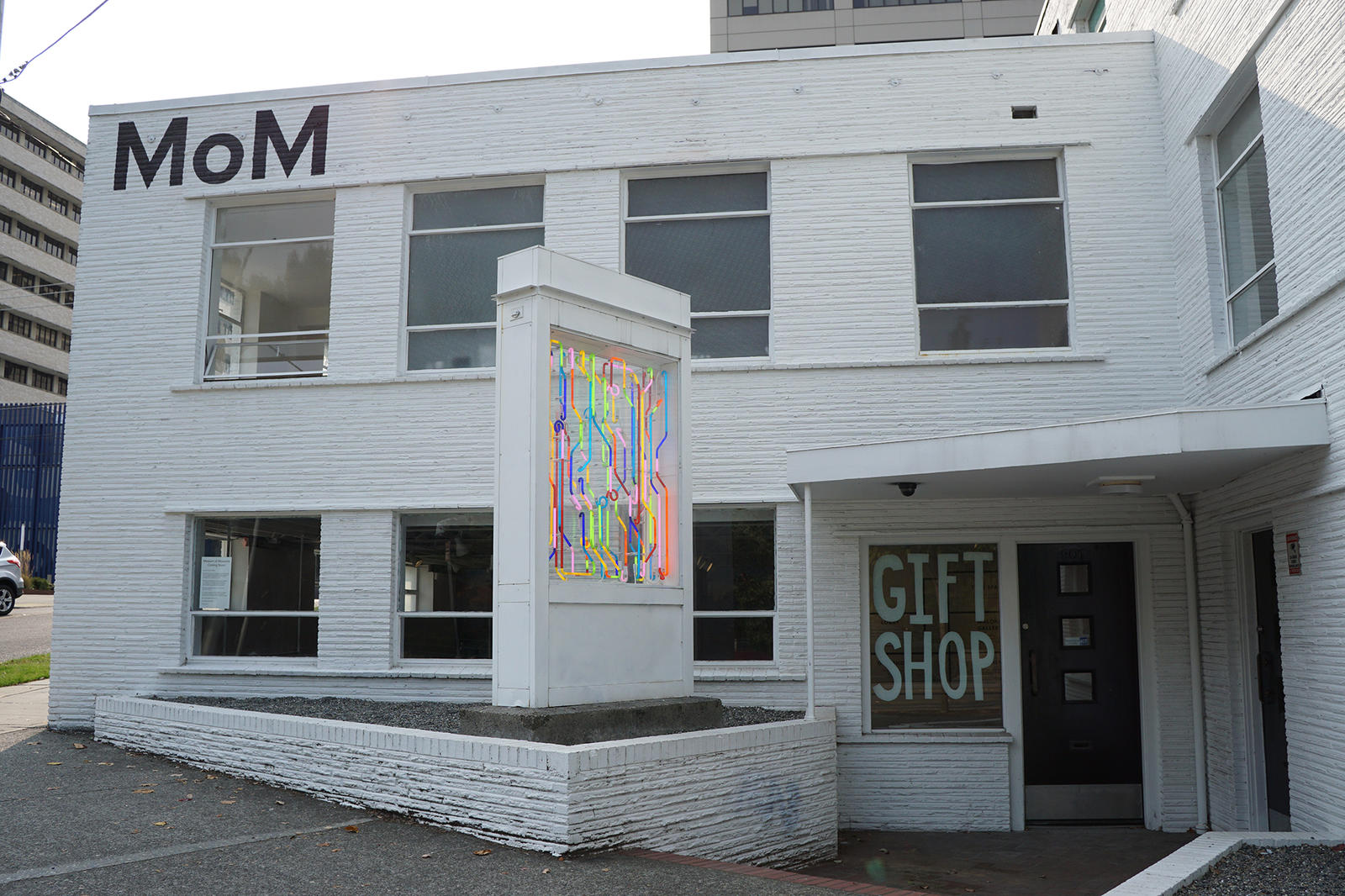
Seattle’s new Museum of Museums is located in a former medical office building owned by the nonprofit Swedish Health Services. It took arts entrepreneur Greg Lundgren more than a year to renovate the building’s 8,000 square feet.
Seattle’s new Museum of Museums is located in a former medical office building owned by the nonprofit Swedish Health Services. It took arts entrepreneur Greg Lundgren more than a year to renovate the building’s 8,000 square feet.
“I’m totally stressed,” says arts entrepreneur and curator Greg Lundgren, as he pets a stuffed toy (panda body, giraffe head) displayed in the gift shop of Seattle’s soon-to-open Museum of Museums. He pauses. “But it’s not my first rodeo.”
Lundgren’s rodeo usually goes like this: Find an empty property slated for future development or otherwise languishing, fix it up and reopen it as an innovative space for local art. But transforming a derelict midcentury medical office into a contemporary art museum amid a pandemic? That’s next level, even for Lundgren.

The museum — with three floors of galleries, a gift shop, permanent outdoor art and a four-seat theater — should have opened a year ago. Lundgren signed a lease on the expansive space at the border of Capitol Hill and First Hill in June 2019. But he soon hit a serious permitting snafu that dragged on for months. And then, you guessed it: the pandemic. Next: Look, don’t touch: Seattle museums reopen at last
“If there were a giant earthquake it would not surprise me,” Lundgren says dryly, as he gives me a tour of the space. Artworks for the inaugural show, Goodwitch/Badwitch (curated by Bri “The Hoodwitch” Luna and Lundgren), lean against walls, awaiting installation.
Upstairs, an immersive, candy-colored installation by Neonsaltwater and Brian Sanchez is still in progress; for now a palm tree shimmers through a sheet of hot-pink frosted glass. Downstairs, selfie lovers can bask in the fully floral bathroom by artist Elisa Maelen. In the gift shop, bathing, bare-breasted “Bigfeet” creatures in local painter Crystal Barbre’s 20-foot-long mural await eventual visitors. Although the pop-up show Mask Parade is already open on weekends to the public, the museum fully opens (at 25% capacity and by appointment) to members later this month, and in November to the general public. If all goes right, that is.

“We’re all charting new territory,” Lundgren says. “I feel like we have machetes and we’re just going through the jungle.”
Others might have given up, turned around and gone home. Not Lundgren. His conviction that Seattle is both artistically and monetarily rich — and that he can foster a stronger relationship between artists and collectors to avoid a creative brain drain — keeps him going.
In the stairwell at MoM, a black decal on a rare bare wall encapsulates Lundgren’s point: “There is no version of a great city with a declining artist population.”
Margo Vansynghel is a reporter at Crosscut focused on arts and culture. Find her on Twitter @Margo_vs or email at Margo.Vansynghel@crosscut.com.
Agueda Pacheco Flores is a reporter at Crosscut focused on arts and culture. Find her on Twitter @AguedaPachecOH or email at agueda.pachecoflores@crosscut.com
by Katie Wilson at Crosscut
It’s been a long time since America has thought very much about trustbusting. The phrase still calls to mind a grinning, cartoon Teddy Roosevelt, swinging his big stick at Standard Oil.
But as of this month, trustbusting is officially back on the table. The quarry this time isn’t Big Oil, Big Railroads or Big Steel, but Big Tech — including our homegrown giant, Amazon. On Oct. 6, the House Judiciary Committee’s Antitrust Subcommittee released a report on competition in the digital economy, including a suite of recommendations to revive antitrust enforcement and strengthen antitrust law. It was the culmination of a more than 16-month-long investigation into the market dominance and business practices of Apple, Amazon, Google and Facebook “to determine how their power affects our economy and our democracy.” Just this week, the Justice Department followed up with an antitrust lawsuit against Google.
This is the introduction to a series on anti-trust and Amazon at crosscut.com
Some of today’s practices recall that earlier era of trusts, cartels and monopoly power. In the late 19th and early 20th centuries, John D. Rockefeller Sr. strong-armed merchants into selling only Standard Oil. Today, Google and Apple use exclusionary contracts to prevent suppliers, distributors and customers from doing business with their competitors. Not only did Standard Oil receive deep concessions on shipping costs from colluding railroads, it got intelligence on rival oil refiners’ prices, enabling the company to go lower. Today, Amazon uses its god’s-eye view of the independent sellers on its platform to launch competing products. What Standard Oil did to the small refineries, undercutting them before gobbling them up, Amazon did to Diapers.com.
But today’s landscape is also different. Each of the four tech giants controls critical pieces of the infrastructure of the digital world where so many of us spend so much of our time and our money. Often they compete in marketplaces they themselves run, a fact that isn’t novel in itself (your favorite chain grocery store likely has a house brand) but which assumes new significance in the growing and hyperconcentrated world of e-commerce, where platforms shoulder little risk and collect information on individual sellers and customers in minute and exhaustive detail. Most of all, what is new is the extent to which we depend on these corporations, not just as consumers, but as humans, so that being mined for data becomes the price of admission to modern life. Issues of competition and antitrust blend with larger questions of privacy, access to information, the health of our public sphere and the future of our democracy.
That was the starting point for congressional scrutiny of Big Tech back in 2018. Facebook CEO Mark Zuckerberg was grilled by both Senate and House committees following the revelation that Cambridge Analytica, a political consulting firm with ties to the Trump campaign, harvested millions of Facebook users’ data to build psychological profiles of likely voters. Questioning ranged beyond privacy to Russian meddling in the 2016 presidential election, racial targeting, censorship, “fake news” — and monopoly power. Sen. Lindsey Graham, R-South Carolina, asked Zuckerberg if he thought Facebook was a monopoly. “It doesn’t feel that way to me,” he replied.
Thanks to Sybil-Ann!
A thief in Paris planned to steal some Paintings from the Louvre
After careful planning, he got past security, stole the paintings,
and made it safely to his van.
However, he was captured only two blocks away when his van ran out of gas.
When asked how he could mastermind such a crime and then make such an obvious error, he replied,
‘Monsieur, that is the reason I stole the paintings.’
I had no Monet
To buy Degas
To make the Van Gogh.’
See if you have De Gaulle to
send this on to someone else….
I sent it to you because I figured
I had nothing Toulouse.
 | Virus-free. www.avast.com |




 Reload document
  Open in new tab