
By Katherine Long Special to The Seattle Times
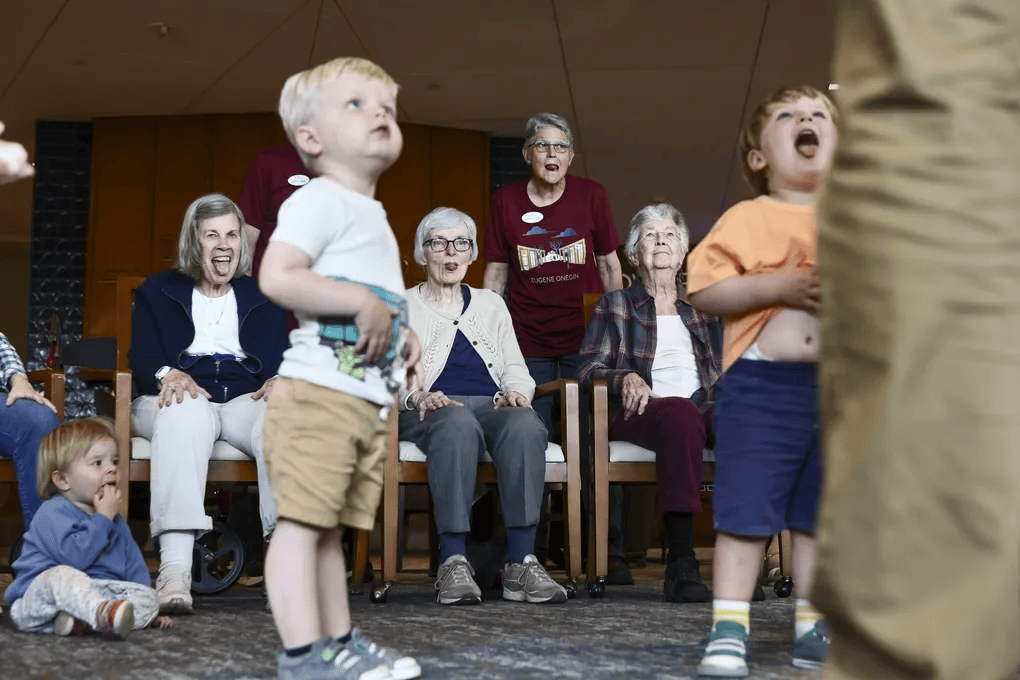
Retired teacher and school librarian Marlene Peters settled into a familiar place in the lobby of Bayview this month and opened a favorite book to read to a dozen squirmy toddlers at her feet.
Although her delivery and cadence were calibrated to hold the attention of 4-year-olds, another audience was also listening closely: about a dozen of her fellow residents at Bayview, a retirement community at the base of Queen Anne Hill.
Peters, 85, has been reading to both children and adults for five years now, ever since she moved into Bayview. In fact, she moved here in part because Bayview offers childcare in its Uptown building — Bayview Intergenerational Children’s Center. “I love to be around children,” she said.
These little students are living and learning in the midst of a community of elders, in a building that’s home to people as old as their grandparents — playing in the same outdoor garden, blowing bubbles together, sitting near one another in the lobby to hear a story.
“There’s so much love back and forth between the residents and kids,” said Nancy Weinbeck, CEO of Bayview, a “life plan community” — a retirement center that offers independent living, assisted living, memory care and skilled nursing. The daycare is “exposing the kids to wheelchairs and walkers and canes and hearing aids, so it’s normal for them, it’s not scary … none of those things are seen as negative,” she said.
“To get a generation of young people embracing older adults that way is so cool,” she added. (continued on Page 2 or here)
Washington is a leader among the states in offering childcare in retirement centers, said Sheri Steinig, director of strategic initiatives and communications for Generations United, a Washington, D.C.-based advocacy group for intergenerational collaboration.
But even here, it’s not a common setup. Only about a dozen Washington long-term care facilities also offer childcare. It’s not easy to run both: These centers must jump through twice as many regulatory hoops — the ones written for daycare and those that govern long-term care
Space in long-term care programs — and also in childcare facilities — is often at a premium. Both sectors also struggle with low worker pay and staff shortages. And Seattle is one of the costliest places in the country to place a child in daycare.
Last March, U.S. Rep. Marilyn Strickland, D-Tacoma, led a bipartisan effort to establish a grant program for long-term care facilities to operate or contract with childcare programs, and facilitate intergenerational activities. In a news release, she described the bill as a way to tackle the “disjointed caregiving infrastructure.”
Bayview is a small program, currently licensed to serve 42 children from 6 weeks to 5 years old in a facility where residents range in age from 62 to 101. The facility, which serves 200 adults, opened in 1961, the daycare in 1996.
Seattle’s oldest and largest intergenerational program is at Providence Mount St. Vincent, known as “The Mount,” in West Seattle. The “living care community,” which offers a continuum of elder care for 400 adults, also runs a preschool with space for 103 children, from 6 weeks to 6 years. The building was specifically designed to serve both programs.
The Mount’s program is a widely heralded model — it’s been the subject of a prizewinning documentary, “The Growing Season,” and has frequent international site visitors, including a news crew from Australia, which produced a 17-minute segment about the program.
The Mount’s program has been around for 35 years, and has scores of preschool graduates who are now adults in the workforce, with families of their own, said Molly Swain, director of The Mount’s foundation. Swain said kids who went through the preschool tend to be more comfortable with older adults, and more likely to initiate a conversation with someone in a wheelchair. A number of them have gone into careers in healthcare.
“Getting to know the elders really changed their lives,” Swain said.
An easy way to stay connected to education. Delivered to your inbox Thursdays.
Support for older residents and children is woven into the program, which includes singalongs with a resident music specialist and two intergenerational plays a year.
“We have very intentional moments,” said Yona Dembele, director of The Mount’s Intergenerational Learning Center. “It can be as simple as a daily visit into a neighborhood, where children are doing color activities with residents, or making sandwiches for the homeless program.” (The Mount uses the term “neighborhoods” to describe clusters of resident rooms that surround a common kitchen, living room and dining room.)
Dembele said residents are encouraged to drop in to the preschool any time they like, and either join in or propose an activity of their own. Last year, a temporary resident recovering from a hospital stay put on musical theater classes with several classrooms, and directed a play with the children.
Swain described the program as “the antithesis of social media pressures.”
“In today’s world of social media, it’s imperative children learn how to have in-person relationships, and especially across the generations,” she said.
Kids at The Mount typically live in the West Seattle neighborhood, and many caregivers who work at The Mount also enroll their children in the program. “There’s peace of mind, knowing their children are in good care,” Dembele said.
Bayview, which modeled its program on the one at The Mount, also does a weekly music program, and adult residents often come down from their apartments to hang out in the garden with the children, just to watch them play, said Frani Pelaez, director of the center.
In a city — and state — where childcare costs can rival in-state college tuition, both programs say they’re able to keep daycare costs competitive.
The Mount is part of Providence Health & Services, a national not-for-profit Catholic health system, and raises money through its foundation to keep costs down for the daycare and for long-term residents, many of whom are on Medicaid. “We significantly fundraise to make this possible,” Swain said.
Bayview is a nonprofit, located on property originally owned by Charles A. Kinnear, a member of a pioneering Seattle family who gave the land to the First United Methodist Church for the care of the elderly and/or children. “The vision has always been an intergenerational one,” Weinbeck said.
Weinbeck called the programs a rarity, but said “it really shouldn’t be unique. … We don’t connect anymore with the generations like we used to.”
Earlier this month, while her neighbor Marlene Peters read a book to the kids at Bayview, Debbie Cutter joined in, watching the dozen wriggling bodies on the carpet of Bayview’s lobby.
“It’s energizing for me to be around the raw energy of all the kids,” said Cutter, 67, who is president of Bayview’s residents council. “It picks me up and makes me happy.”