
Democracy flourishes when we cultivate a shared civic culture—and leaders have the courage to build it
Democracy flourishes not only through laws, elections, and institutions, but through a shared civic culture that invites people into a common national story. Few figures illustrate this truth more clearly than First Lady Helen Herron “Nellie” Taft, whose leadership strengthened democracy by widening who felt included in it—and how they experienced i
Every spring, when millions of Americans crowd around Washington, D.C.’s Tidal Basin to admire the cherry blossoms, they participate in a civic ritual rooted in Nellie Taft’s vision. Inspired by her travels with her husband, William Howard Taft, to the Philippines and Japan—where she admired Luneta Park in Manila and the cherry-lined promenades of Tokyo—Nellie arranged for a gift of more than 3,000 cherry trees from Japan to the United States. This was not merely an act of beautification—it was a deliberate expression of peace among nations, unity among citizens, and civic pride at home. When she planted the first two trees in 1912, Nellie was seeding a deeper idea: that democracy depends on shared public spaces, common experiences, and a civic culture that draws people together.
Nellie’s belief in civic culture was shaped early in life. Born in Cincinnati in 1861, just two months into the Civil War that led to the abolition of slavery, her earliest memory was of Union soldiers returning home and celebrating peace. She grew up in a large, politically engaged family that combined privilege with high expectations. Her father was a lawyer, state senator, and friend of future presidents Rutherford B. Hayes and Benjamin Harrison; her mother was intellectually curious and steeped in the public service tradition, with a father and brother both serving as U.S. Congressmen. From childhood, Nellie absorbed the idea that democracy was not abstract—it was lived, witnessed, and celebrated together.
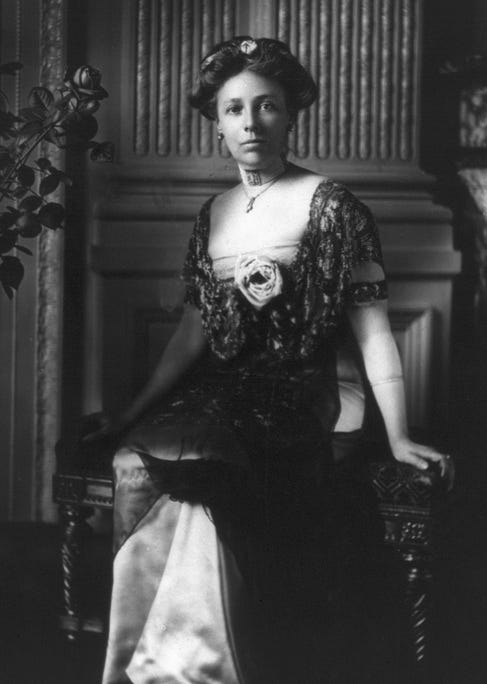
Helen Herron Taft. Photograph, 1911. Library of Congress Prints and Photographs Division.
Gifted and ambitious, Nellie was raised to question limits. She read voraciously, studied history and current events, excelled as a pianist, and learned French, Spanish and German. Yet she came of age in a society that expected women to be modest and domestic rather than outspoken and ambitious. The tension between her aspirations and social norms led to periods of insecurity and depression, but it also forged a rebellious independence. She smoked, drank, and gambled in public and found no comfort in organized religion. Rejecting conventions that constrained women, she challenged social, racial, and political barriers throughout her life—always with an eye toward expanding who could participate fully in public life.
Before she could open doors for others, Nellie had to push against limits placed on herself. She worked as a teacher, dreamed of running her own school, organized literary salons, and immersed herself in the lively civic life of Cincinnati. Her ambitions reflected a conviction that democracy requires active, educated, and engaged citizens—and that women belonged in that effort.
A defining civic moment came when Nellie was just sixteen. Attending an intimate White House reception honoring President and Mrs. Hayes’ silver wedding anniversary, she later recalled declaring, with remarkable foresight, “Someday, I shall come back to this house as its mistress.” When she married William Howard Taft in 1886—after repeatedly rejecting his early proposals—their relationship evolved into an unusually equal partnership. Their correspondence over nearly fifty years reveals mutual respect and shared responsibility for public life, reminiscent of Abigail and John Adams.
One aspect of the relationship became clear—Nellie was far more politically ambitious for her husband than he was for himself. While William Howard Taft preferred the quiet life of the law, she saw him as a steward of the republic. She urged him to accept roles that expanded his service to the nation, from Governor-General of the Philippines to Secretary of War, and ultimately to the presidency. In 1908, he accepted the Republican Party’s presidential nomination, succeeding Teddy Roosevelt in 1909, and wrote to a friend that he felt “like a fish out of water.” In later years, Taft conceded, “I never wanted to be President. I wanted to be Chief Justice…. That was my ambition. The Presidency was my wife’s.”
Nellie Taft’s ambitions did not cool when he took office. As First Lady, Nellie refused to remain a ceremonial figure. She broke precedent by riding beside her husband in the inaugural procession in place of outgoing President Roosevelt, sat in on meetings with her husband, advised on appointments and communications, and openly participated in governance. Her presence underscored a broader democratic message: leadership is strongest when it draws on a wider range of voices and perspectives.
She also worked to widen participation for those excluded from power. Nellie advocated for women’s education and incremental advances in women’s suffrage, expressed sympathy for Progressive-era labor reforms benefitting women and immigrants, encouraged the appointment of women to advisory roles, and resisted racial exclusion by retaining and supporting African American staff at the White House. In these ways, she strengthened democracy not by rhetoric alone, but through practice.
Perhaps most enduring was Nellie’s reimagining of Washington, D.C. and The White House as civic spaces belonging to all Americans. She championed the beautification of the Potomac waterfront, created public bandstands with free performances by the Marine Band, and opened the White House to music and theater. She viewed it unapologetically as the “people’s house.” These efforts reinforced a shared civic culture—one in which citizens experienced democracy not only through ballots and institutions, but through beauty, culture, and collective gathering.
Then, in a cruel twist of fate, just two months after moving into the White House, Nellie, at age 48, suffered a debilitating stroke during a cruise with the President down the Potomac River to Mount Vernon. The stroke paralyzed the right side of her body and caused aphasia that left her unable to speak coherently. The First Lady who had actively spoken for women, advised the President, and advocated for other groups of Americans could no longer form words or walk.
Through arduous rehabilitation, including her husband reading to her at night, she returned quietly but resolutely to public life, embodying the resilience she had long demanded of herself and others. Even as political defeat followed—culminating in Taft’s loss to Woodrow Wilson in a fractured 1912 election—her impact endured.
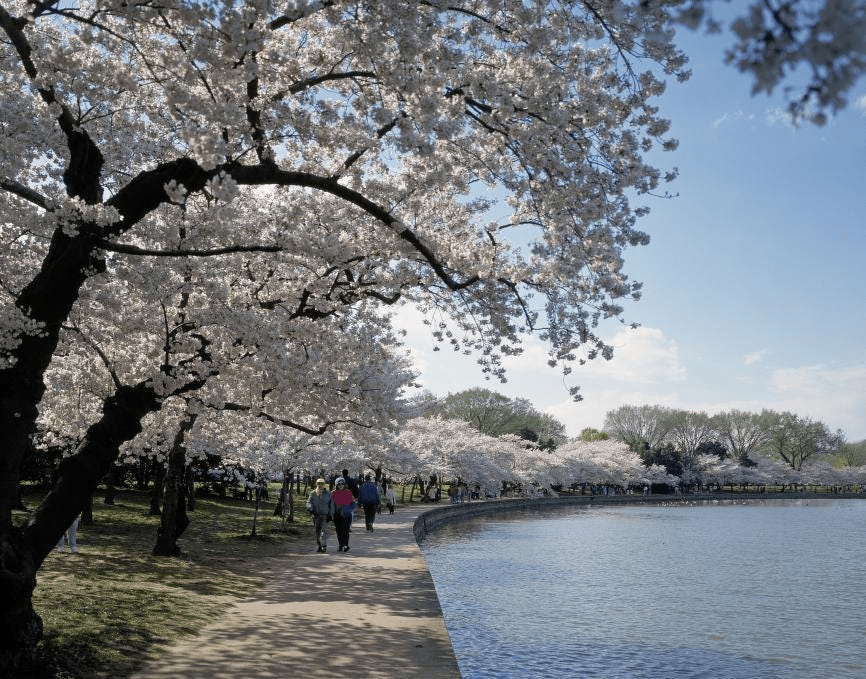
Carol M. Highsmith, Cherry Blossoms around the Tidal Basin in Washington, D.C. Photograph, before 2010. Library of Congress Prints and Photographs Division.
In just four years as First Lady, Nellie Taft transformed the role into one of genuine civic leadership. She broadened participation, strengthened national identity, and reminded Americans that democracy lives not only in institutions, but in shared experiences that bind people together. Each spring, as cherry blossoms draw millions into a common moment of reflection and joy, they stand as living proof of her enduring lesson—that democracy flourishes when we cultivate a shared civic culture—and when leaders have the courage to build it.
John M. Bridgeland is Founder & CEO of More Perfect. He is former Director, White House Domestic Policy Council for President George W. Bush, and former Member, White House Council for Community Solutions for President Barack Obama.