
Submitted by Eugene Carlson
By Niki Stojnic Seattle Times Aug. 17, 2026 at 6:00 am Updated Aug. 17, 2026 at 6:00 am
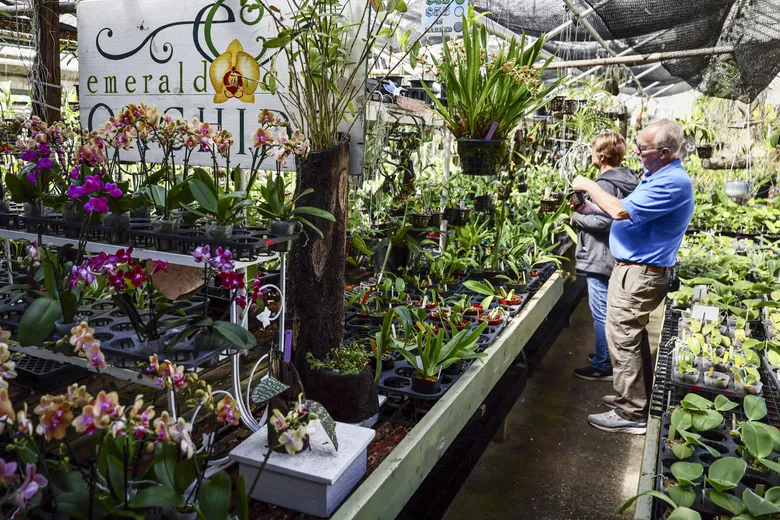
Michelle and Al Vaas browse an expansive aisle at Emerald City Orchids in Tacoma. (Kevin Clark / The Seattle Times)
SLIM GREEN-WHITE ROOTS cascade from hanging pots. Lush green leaves and pseudobulbs sprout from burled brown tree fern logs. Bright flowers perch along green or purple-red spikes. And rustic hand-painted signage tells you what you’re looking at: vandas, oncidiums, dendrobiums, bulbophyllums.
Emerald City Orchids boasts the largest retail selection of orchid varieties in the Pacific Northwest. The two greenhouses at its 3,500 square-foot shop envelop visitors in moist, tropical air. A riotous collection of plants includes everything from easy growers to rare species.
Families may come in searching for a new houseplant, while orchid owners come seeking advice. The shop also hosts classes, usually on weekends, which offer a tour of the greenhouse, growing strategies and tips, and repotting and mounting guidance.
If you think orchids are delicate hothouse specialties beyond your tending capabilities, Emerald City’s owner Joe Grienauer and his small team of orchid enthusiasts stand ready to change your mind. Anyone can nurture these beauties — some of which thrive on neglect — you just need to find the right one.
Source: Esri (Map by Mark Nowlin / The Seattle Times)
“If you are just slightly motivated to take care of a plant, we can find an orchid,” says Grienauer, who started the business as a wholesale distributor in his Ballard garage in 2008. “We do a lot of matchmaking, we try to match the person to the orchid.”
That includes learning about the type of orchid you like, where you want to put it, and what your plant care habits are. He says there are two types of plant growers: doters and neglecters. Doters check on every plant daily, “and then there’s the rest of us,” Grienauer says. “We’re all neglecters.” There are plenty of orchids for this latter group.
Looking for a little world to call your own? Emerald City Orchids offers terrariums created by Mizu Mori. (Kevin Clark / The Seattle Times)
Some 28,000 orchid species exist in the world. They grow in almost every climate and flower in nearly every color. (About 30 grow naturally in the Pacific Northwest, though they’re very different from the types that brighten indoor spaces.) A majority (70% to 80%) are epiphytic, meaning their roots get their moisture from the air and surrounding debris rather than soil, and are the showier kind that thrive in the tropics. About half of the 200 species of orchids that grow in the U.S. are native to Florida, for example.
Orchid nurseries are common in Florida, California and Hawai’i, much less so elsewhere in the U.S. “When I started in 2008, there were six orchid nurseries in the state of Washington,” Grienauer says. Those have since closed. (Smaller outfits like Little Orchid Annie and Orchids by the Lake sell mainly online.)
For many people, one orchid often leads to more. Grienauer says that part of the reason is that there’s so much to learn about these diverse plants, and that’s irresistible. “You can do it your whole life and still find new things to learn, and it makes it a really engaging plant to grow.”
Among many interesting facts: Orchids rely on pollinators for fertilization, and they’ve evolved accordingly. “There’s orchids that mimic a female insect, and the males land on them to mate,” Grienauer says. “There’s orchids that offer very addictive chemical substances to literally addict their pollinators. Some of them have literal booby traps on them, there’s a trap door that pinches the bug into the pollen.”

Directional signs aid in browsing the expansive aisles of Emerald City Orchids in Tacoma. (Kevin Clark / The Seattle Times)

The Bulbophyllum lobbii was named for the botanist Thomas Lobb. (Kevin Clark / The Seattle Times)
The shop’s turtle basks in the warmth of Emerald City Orchids in Tacoma. (Kevin Clark / The Seattle Times)
The Vanda Pintuwadee has eye-catching spots at Emerald City Orchids. (Kevin Clark / The Seattle Times)
Caption: An air plant tucked inside an ukulele, left, and a Myrmecophila Christinae from Palmer Orchids at Emerald City Orchids in Tacoma. (Kevin Clark / The Seattle Times)
Caption: An air plant tucked inside an ukulele. (Kevin Clark / The Seattle Times)
Grienauer knew nothing about orchids in 2004 when he scored a job driving a delivery truck for Baron’s Orchids in Morro Bay, Calif. He turned out to be a talented salesman, promoting the orchids to house stagers, flower shops and others. As customers began asking questions about plant care, he researched the answers. He started going to orchid society meetings to learn more. Much like the pollinators, he was drawn right in.
The space Emerald City Orchids occupies has been nurturing plants for more than 100 years. The oldest portion was constructed before 1896. In 1920 Herbert Brown opened Brown’s Conservatory of Flowers there, then built the first greenhouse in 1937. A second greenhouse was added in 1946, followed by a distinctive glass-walled retail space in 1948.
Back when Grienauer was working out of his garage, Brown’s was one of his wholesale clients. Eventually he moved to the Brown’s Flower greenhouses and in 2023, the Brown family sold him the building, at which point his orchids took over.
Aside from orchids themselves, the shop carries orchid mounts, pots and supports. A small cavelike area is devoted to Mizu Mori terrariums, another Seattle-area niche plant retailer.
Grienauer sources orchids several ways, ordering and farming reliable “superstars,” and picking up seedlings at orchid shows across the U.S. and abroad and seeing what thrives. He recently took two seeds to a propagation lab in Seattle called Standard Orchid to see how they will combine.
He extends his experimental mentality to his customers. “What’s great about orchids is that they’re flexible. There’s a lot of ways to grow it, and none of them is correct.”
Whether sourcing for his business or helping customers find what they’re looking for, Grienauer loves the hunt. “There are different plants for different people, and that’s part of the fun. Some people, I swear it’s true, they have an orchid soulmate.”
Emerald City Orchids: 4734 S. Tacoma Way, Tacoma; 206-802-8256;
emeraldcityorchids.com
BY THE NUMBERS
3-8 years: Approximate time it can take for an orchid seedling to reach blooming maturity, depending on type
45 million to 55 million years: Age of the oldest documented orchid fossil, found in Baltic amber
3,500 square feet: Size of Emerald City Orchids nursery
28,000: Approximate number of orchid species in the world
200: Approximate number of U.S. orchid species


