Policies that gave addicts clean needles and places to use drugs were intended to reduce harm. They created a “zombie apocalypse.”
By Michael Powell in The Atlantic
Photographs by Dana Golan
Late last year, I walked roughly a mile from downtown Seattle to the working-class neighborhood of Little Saigon and came upon a montage of human despair. An open-air drug market stretched along the intersection of 12th and Jackson: about 250 people, many smoking fentanyl or bent over in the thrall of the drug, tilting as if mid-fall. Three women lay passed out on the sidewalk, their chests slowly rising and falling, while fellow addicts stepped over them and dealers made sales. Young boys, schoolbags on their backs, stood on a far corner and watched.
I walked around the block to the Hoa Mai playground, named for a Vietnamese flower that signifies rebirth. City workers had installed gates to keep drug users away, but at 4 p.m. on a Wednesday, I counted 27 people smoking drugs and nodding off. No children were in sight.
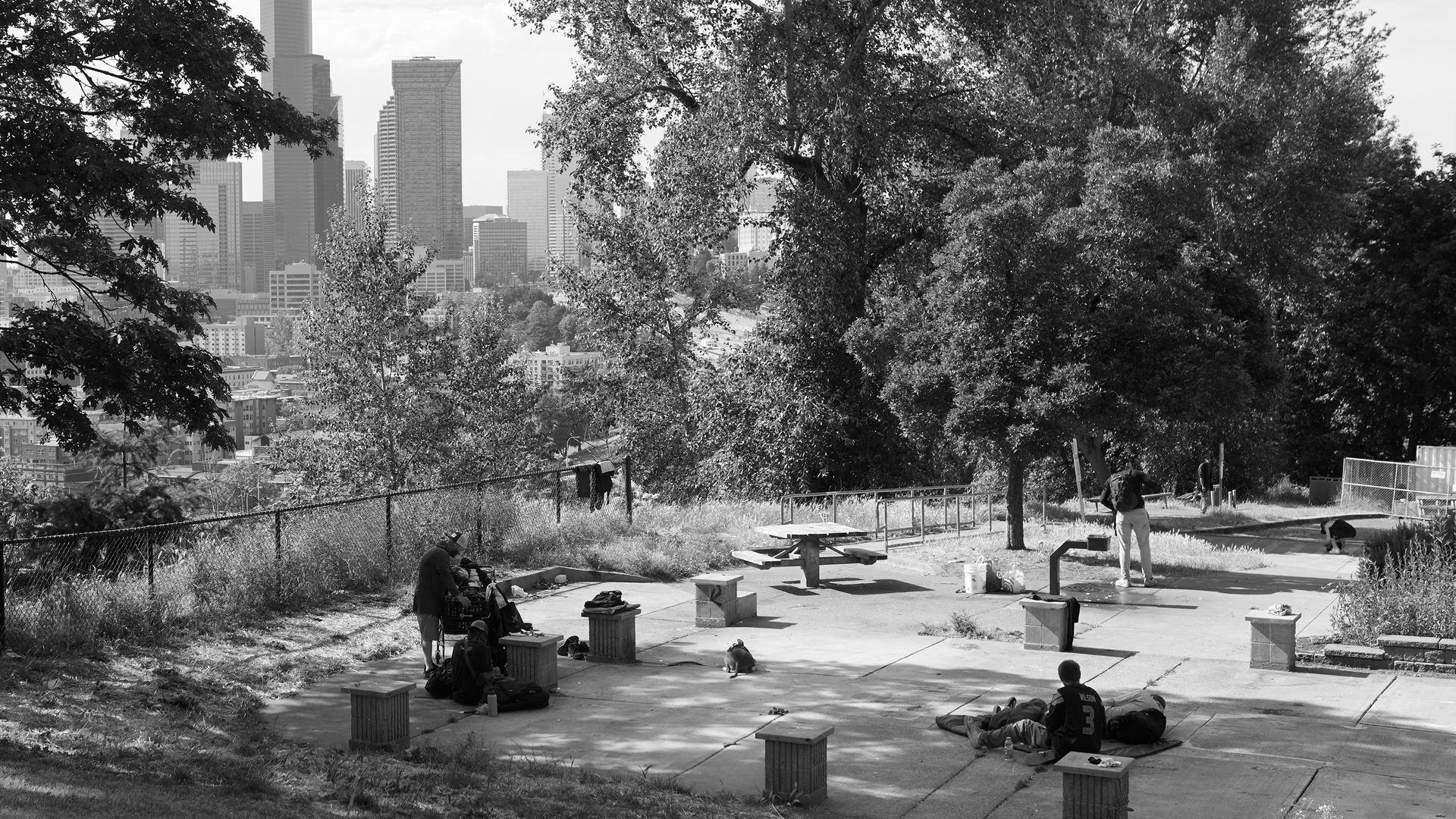
Half a mile to the south, in the Beacon Hill neighborhood, I visited a 10-acre park named after the Filipino nationalist Jose Rizal. It has a playground and the remnants of an apple orchard, and at night you can peer downtown and see the city lights. As I arrived, a drug user squatted next to a child’s slide and relieved himself. Others had set up tents and colonized the park pavilion, where they heated fentanyl on tinfoil and inhaled the fumes with glass pipes. A few went old-school and injected it.
Across the street, I spoke with Angelina Monsegur as she waited at a bus stop. When she was a kid, she told me, she and her father ate candied apples in the park and watched Fourth of July fireworks. A few weeks earlier, she and her 6-year-old daughter had gotten on the bus and seen a man smoking fentanyl on board. “Are you serious?” she’d shouted at him. “My daughter has asthma.” I asked if she had called the police, and she smiled at my naivete. “All the city does is send out teams who hand out aluminum foil and fentanyl pipes.”
Seattle is one of the wealthiest and best-educated cities in the world. It can afford to try various strategies to address its drug epidemic and high rate of fatal overdoses. Yet many of the city’s leaders, apparently supported by voters, view enforcing bans on the open sale and use of narcotics, and forcing addicts off the streets and into treatment, as akin to an act of state repression. (continued on Page 2 or here)