
“With a son on the fire line, what I’ve learned about protecting the air we breathe”, by Matt Willis – published by Your Local Epidemiologist.
Ed note: This morning Seattle’s air is quite clean and free of the smoke from fires burning is British Columbia and Eastern Washington. Yes, the west winds are currently protecting us in Western Washington. But things can change as the winds do. This article gives us some practical steps we could take.
The text came on July 27: Made it to Bend. Heading to the fire line tomorrow.
My son just finished his wildland firefighting certification. He’s spent the summer working as an EMT and was sent to the fires burning in Oregon. He’s 22, and this was his first fire.
For years, I approached wildfire smoke as a health professional: caring for patients with smoke-related illness, writing advisories as a health officer, and researching its health impacts. But as a dad, all that boiled down to one urgent question: when the skies fill with smoke, how do we keep the air we breathe as clean as possible?
I went deep into air filtration. My son’s exposure may be more extreme, but the lessons are increasingly relevant for all of us. This is what I learned.
Yes, wildfires are increasing.
When I’m not writing with Katelyn for YLE, I work with climate scientists to model the health impacts of climate change. Our report will be out in December (stay tuned), but here’s a teaser—the increased burden of wildfires we’re feeling isn’t a one-summer fluke. Even the best-case scenarios show an upward trend in wildfire size, frequency, and intensity until we can slow global warming.
This doesn’t just matter for those of us with houses in dry areas. Wildfire smoke risk isn’t limited to “fire county.” Our most fire-prone states are in the West, and prevailing winds blow east. In late July, smoke from the fire my son was fighting in Oregon reached Florida.

Wildfire smoke plume, July 29, 2026. Source: NOAA
Long-term climate models indicate that we can expect increased smoke exposure in the coming years.
We need to adapt quickly. That starts with filtering air.
We breathe in about 2,000 gallons of air a day at rest—almost enough to fill a swimming pool. On smoky days, every gallon we take in carries potentially harmful compounds. The most damaging bits are smaller than 2.5 microns (a centimeter has 10,000 microns), called “PM 2.5”, which is much smaller than a human hair.
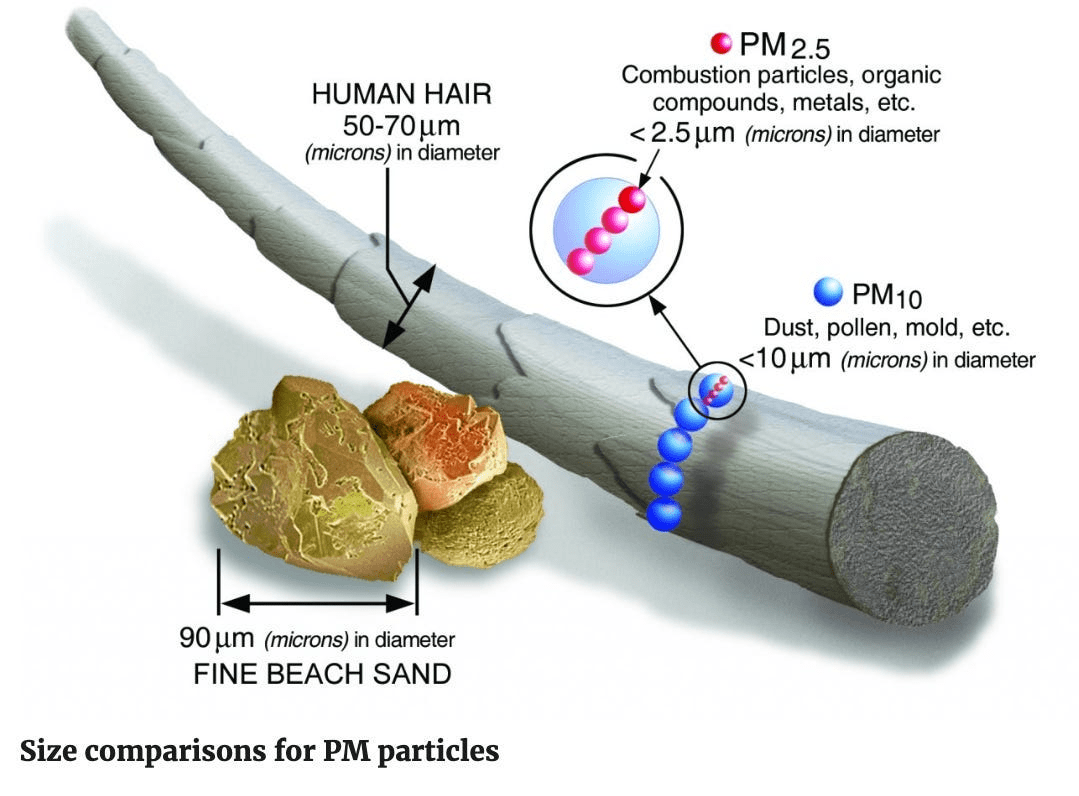
Source: EPA
So, any air filtration for wildfire smoke needs to have a very fine weave. On smoky days, scrubbing the particles out of that air before we breathe it can be surprisingly simple. Outside, it’s a mask. Inside, it’s your home’s air filtration system.
Outside masks are a neglected tool.
A well-fitted N95 mask is highly effective against wildfire smoke. A 2025 review of 33 studies found that N95 face masks removed up to 94% of PM2.5. The authors also concluded that “masks were relatively underutilized” in wildfire response.
Until recently, masks have not been prioritized in wildfire response. In fact, until last year, wildland firefighters weren’t allowed to wear anything beyond a bandana on the fire line. Somehow, despite mountains of evidence of the benefit, the U.S. Forest Service only authorized voluntary N95 use for firefighters in 2025. This is a massive occupational health failure that harmed generations of firefighters. It’s finally being corrected, just as my son joins the ranks.
That history also helps us understand the impact of repeated, unprotected– and preventable exposures. Career wildland firefighters have an estimated 8–43% increased risk for lung cancer and a 16–30% increased risk of cardiovascular death, depending on years of service and season intensity. A more recent study of almost 13,000 firefighters, looking back over 25 years, found that emphysema, pneumonia, asthma, and cardiovascular disease all increased with more fire line hours.
The wide range of effects isn’t surprising—the smallest inhaled particles damage lung tissue directly and enter the bloodstream, causing inflammation in sensitive blood vessels, including those in the heart and brain. These health impacts aren’t just during an event, but accumulate, fire after fire. This “dose-response” curve means higher exposure levels lead to worse health outcomes—and any measure that reduces exposure helps.
What this means for you: Wear a well-fitting N95 mask when you’re outside anytime it’s smoky. An air quality index (AQI) of 150 is a good trigger point for masking up. People in sensitive groups should consider masking at an AQI of 100 or higher. (Check AirNow’s Fire and Smoke Map for AQI in near real time during a fire.) I’m relieved that my son and his crew finally have access to the protection we’ve been promoting to the public for years.
“Go indoors” is only a start.
Here’s something I wish I’d been clearer about in twelve years of writing smoke advisories as a health officer: “move indoors” treats your house like it’s a sealed box, and it isn’t. AQI is generally measured outdoors, but being inside doesn’t automatically protect you.
Air moves through gaps, doors, windows, even walls. Researchers tracking indoor and outdoor air side by side during smoke events (the “infiltration ratio”) have found that, without indoor filtration, 60% of outdoor pollution can enter indoors within hours. If the AQI is 300 outside, it can approach 200 inside without filtration.
With proper filtration, the indoor/outdoor ratio can drop below 20%. Your indoor AQI can be below 50 on the same day the outdoor AQI is 300.
What this means for you: Clean indoor air.
Every home can have good air filtration through a few simple steps:
- Know what kind of system you have. If your home has vents blowing heated or cooled air and a thermostat, you’ve got a central air system—it already has a filter, and that’s your main asset. If your house uses radiators, baseboard heat, or window units, you’ll probably need portable filters.
- Use the right filter. For central air, look for the MERV rating, a 1 to 16+ scale for how fine a particle it catches. MERV 13 is recommended for PM 2.5 in smoke. Most systems come with MERV 8 as default, so you may need to upgrade. For portable purifiers, look at two factors—the filtration type, and how large an area it can purify. Look for HEPA-rated filters, which effectively capture 99% of wildfire smoke particles. For room size, CADR (clean air delivery rate) is the number of square feet of air it can filter per minute. As a rule of thumb, CADR should be close to your room’s square footage. (A 10 ft by 10 ft room is 100 square feet and would need a filter with a CADR of 80-100.)
- During a smoke event, run it continuously, not just on “auto.” Filtration only works while it’s running. A central system on “auto” may only cycle for a few minutes an hour. During a smoke event, switch the setting to “on” so air keeps moving through the filter. Portable purifiers should run around the clock, too; shutting one off lets a room’s air quality slide back within an hour or two.
- Pick one room and make it your clean-air refuge. If you’re using portable filters, you don’t need to filter the whole house. One well-sealed room, usually the bedroom, gives your household somewhere reliable to breathe easy and sleep.
- Close the gaps before smoke season, not during it. Weatherstripping around doors and windows makes the house less leaky and improves the inside/outside ratio. For renters, removable weatherstripping, draft snakes, or even a towel under a leaky door can help.
- A box fan can get you most of the way there. A box fan paired with a MERV-13 filter taped to the intake side costs a fraction of a purifier and effectively captures fine particles. It’s also fully portable, which helps if you’re renting or moving between rooms.
While we can take personal measures, we’re also seeing promising policies that will help bake some of these protections into more resilient communities. These include building codes that mandate MERV-13 filters, rebates for portable HEPA filters, and free mass mask distribution policies for smoky days.
Bottom line
My son is home now, safe and sound. He slept in a trailer near the fire, where AQI readings reached the 600s. I texted him daily, probably annoyingly, reminding him to wear his N95 mask outside and run the HEPA filter in his trailer. I knew what stood between him and hazardous air was technology that’s available to all of us. These are simple measures, but getting the basics right is more than half the battle in public health.
Most of us won’t ever fight a fire at its source. But we can decide, before the next smoky day arrives, how ready we’ll be to respond to it.
Dr. Matt Willis is the author of Your Local Epidemiologist in California. He’s served as a primary care physician, a CDC epidemiologist, a public health officer for Marin County, and a climate researcher. He lives in Marin with his family and their dogs, Teddy and Ramona.